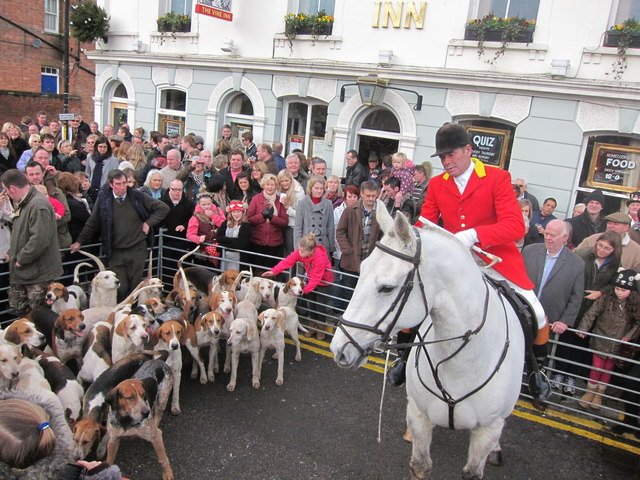
Boxing Day Hunts still attract crowds & violence.

Boxing Day Hunts still attract the crowds, demonstrators and violence, but why?

Sixteen years after hunting was banned the unnecessary Boxing Day Hunts gather and take place on the pretext of preserving rural tradition and these attract the inevitable controversy and conflict which has accompanied them since the Hunting Act 2004 was introduced.

The Act was supposed to stop hunting and settle all the arguments once and for all, but as with most animal protection law it has failed dismally and we still must put up with all the nonsense caused by the red-coated individuals who use every excuse to continue their hobby and flout the law and escape prosecution.

One such “hunt” gathers each year in the picturesque Kentish town of Tenterden, once my childhood home, where every 26th. December at around 10 a.m. I had a birds-eye view of the hunt from my bedroom window  when they noisily assembled outside 70 High Street where we lived above my father’s shop.

The annual day of chaos has economic benefits for the town and is therefore welcomed.

Although an extremely picturesque sight it also caused chaos as thousands of people from all over the district piled into the usual sleepy town and gridlocked it for two hours or so until  the Hunt, suitably imbibed with drinks from the Vine Inn Public House next door, cantered through the melee to the sound of horns like the charge of the Light Brigade to cheers and waving from the onlookers. This annual chaos is of course welcomed by the town because of the economic benefits involved.

I watched this annual event from about 1957 until I left home in 1975 and it was noticeable that its attraction never wavered, while my attitude against hunting became more established despite being countryside bred. During my informative years as a youngster demonstration was almost non-existent and little thought given to the ethical and moral issues of hunting as it was just a lot of fun the day after Christmas.

Four decades on, it is clear that the popularity of these festive hunts is on the increase with more people than ever attending, but why do the hordes continue to descend in this way. Is it to support the Hunt or because they are purely viewed as family entertainment?

The Hounds have always been the biggest draw

From my bedroom it was always obvious that the hounds were the biggest draw with everyone including me wanting to get close to pet them even though they smelled rank due to the poor conditions they are kept under, something most of us were unaware of. They were noisy, boisterous, cheeky and naughty and appeared to be having a great time.

The horses were also a draw, but in hindsight it is difficult to understand why we all stood around, often in freezing weather, for an hour waiting for a group of red and black-coated horsemen and women to finish a morning drink outside a pub.
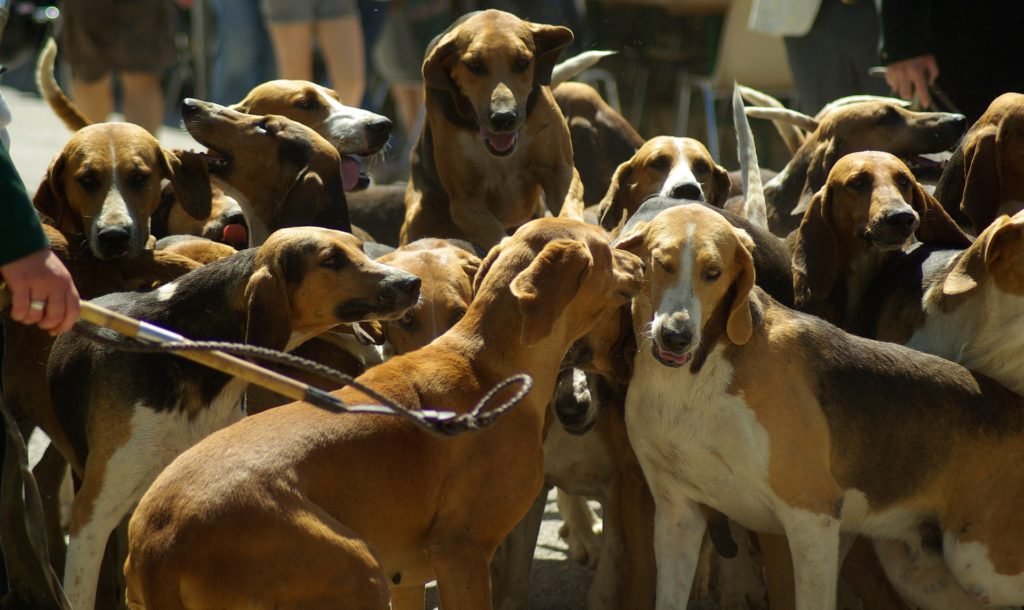
Hunting hounds, fox hunting, cruelty to dogs
The hounds are usually the major draw for crowds at Boxing day Hunt meets.

Boxing Day hunts attract the crowds in ever-increasing numbers.

I no longer have any real association with Tenterden and rarely if ever visit because my father’s shop closed in the late eighties and both my parents have died, but the scenario shows that nothing has changed over the last four decades and despite all the campaigning and hunting ban we are even more happy to support such events despite what they stand for.

The Boxing Day Hunts are just a spectacle for most, but for hunt supporters they are an important way of keeping the debate in the public eye until that Nirvana in the future when hunting is legalised again.

Lets take the hounds out of the equation.

The law makers missed a golden opportunity to put an end to all this violence and mayhem towards both humans and animals on both sides of the debate. All that was needed was to make it illegal to participate in a drag hunt and to own, breed, keep or let loose packs of more than two dogs onto any land whether private or common for any purpose.

Arguments that the dogs (and horses) would all be killed as they are unsuitable as pets was always groundless as there will always be an animal lover on hand to devote their energies into saving them if required.

There is no reason why the meeting up of hunts cannot continue in order to maintain the postcard images and spectacle. There is no harm in allowing them to meet up outside a local village pub on horseback for a few drinks dressed in their red and black finery for the sightseers to clap and cheer as they ride off at the sound of the horns. They can still continue enjoy an exhilarating gallop across the countryside in search of wildlife, but let us dispense with the hound pack and drag hunting and the use of the poor creatures as bargaining chips to continue hunting.

Related Articles:

Top 5 fund-raising tactics of animal charities.

Top eight UK animal welfare charities raised £500,000,000 in 2016

The “saving animals” industry has become a cut-throat commercial enterprise, and there is much rivalry and disunity between the charities manifesting itself in astute advertising and fund-raising. It is a continual game of one upmanship where they each try to outshine each other in the caring stakes or come up with creative ideas that will appeal to prospective benefactors and get a larger cut of the funds available. They operate just like large commercial conglomerates fighting it out for business with advertising agencies being employed to stay one step ahead. They have truly become big business with the top eight UK animal welfare charities raising £500,000,000 in 2016.

Animal charities are quick to disparage their competitors if they perceive a rival has been inefficient or become unpopular through its philosophies and activities. It seems that it is mainly the so-called animal welfare charities that involve themselves in these antics, while animal rights and international organisations tend to focus more on their aims.

There are hundreds of animal charities operating in the UK all with their own agendas, aims and policies filling their own niche in the animal rescue and protection market, so many in fact that opportunities for fund-raising have become increasingly oversubscribed. Fund-raising tactics have become more and more competitive as each charity attempts to keep its head above water and snatch money from their rivals by looking more caring. I sometimes wonder if they have lost sight of their ideals in their attempts to make money and they spend large sums in their quest for funds.

The ends animal welfare charities will go to get your money.

1. Name changing

Many charities particularly the old institutional ones find that changing their names to re-invent and raise their profiles is a good ploy. It increases the awareness of their good work and campaigns and in turn increases their funding as well. In the UK the Cats Protection League (CPL) dropped the “League”and became plain Cats Protection declaring that people didn’t know what the word meant and it made them seem old-fashioned.

In 2003 the National Canine Defence League (NCDL) changed to the Dogs Trust to purvey a more up to date image and show more accurately their work, as they felt the public were not that aware of their existence even though they were the largest dog orientated charity in the UK. By cleverly using the word ‘trust’ they felt the public would have more belief in them, give more money and would make their name easier to remember. They are most famous for their campaign slogan of a dog is for life, not just for Christmas which they have successfully used since 1978, although the sentiment is of little relevance today as abandonment is a persistent problem, but it remains a wonderful marketing ploy during that season.

The World Society for the Protection of Animals (WSPA) changed to simple World Animal Protection (WAP) to be ‘clearer, more distinct and more memorable and the British Union for Anti- Vivisection (BUAV), founded in 1898, has become Cruelty Free International, a clearer, simpler and more positive title in order‘to help achieve more for animals in laboratories’. They believed the public didn’t understand what their old name meant thus preventing people supporting them and by having a ‘British’ name hindered them in their work internationally.

2. Sound bites

Charities introduce new sound bites from time to time to make them seem more caring which is another little subconscious trick, as in the case of the term ‘forever home’ which appeared from nowhere, an incredibly twee but effective catch-phrase, which suddenly became prominent and was quickly taken up by every charity finding new homes for animals, becoming part of everyone’s vocabulary. It is a rather disingenuous use of the term as there is no guarantee that any new home will be ‘forever, but our sentimental side allows us to be taken in by it.

Even the word ‘rescue has become somewhat high-jacked by charities as a fund-raising ploy and is much over-used. Although defined as to save ‘somebody or something from a dangerous or harmful situation‘, it is now used somewhat out of context to label any animal taken from a charity homing centre when in reality most of the animals have not been rescued but are unwanted brought in by owners to be re-cycled. Regardless of background they all become “rescue” animals, although in some cases being rescued from months of confinement and boredom might be the right connotation.

3. When you have gone

Guaranteeing to find a new home for a pet once ‘you have gone’ is a relatively new idea for fund-raising although it is marketed as a service to the community. The idea was quickly copied by most major charities, resulting in the RSPCA ‘Home for Life, the Blue Cross ‘Pets into Care’, Cats Protection Cat Guarantee Card and the Dogs Trust ‘Canine Care Card’ all offering to take on your pet regardless of its age or health once you have died.

Cynics might claim that this is obviously a fund-raising tactic to encourage more legacies from the owners before they die and at least one, the Cats Protection, are open about this by stating ‘the service is free, but people may wish to leave us a gift in their will as a thank you’. The Dogs Trust under their scheme state that ‘we will find your dog/s new owners whose lifestyle and experience match their needs. But if for any reason your dog/s cannot be rehomed we will look after them for the rest of their lives’.

Whether these schemes are the best use of facilities and funds and in the best interests of the animals is arguable. Most humane organisations insist they are constantly overrun, have long waiting lists and need extra funding so guaranteeing space in these circumstances is questionable. Keeping an animal ‘for the rest of its life’ in long-term confinement just like zoo animals, many professionals believe can prove harmful to their mental state because with the best will in the world you cannot give all the care and attention of a proper home. In some cases, euthanasia might be proper if the animal is too old and infirm, but of course this goes against the principle of the organisations and their necessity for raising funds.

One well-known UK charity, boasted in its annual report that it kept a dog for 1,108 days before finding it a home, which equates to 30% of the poor dog’s life. Although a great achievement it conjures up the ethical question of whether it is fair to keep a dog or cat incarcerated for that long.

4. Rivalry in being seen as more caring.

Animal welfare charities are always looking for new opportunities to look more caring than their rivals and will jump on an issue that is topical or in favour. This has happened recently when one charity came up with the idea of helping street pets of the homeless. All the dog charities quickly waded in with schemes and new charities established which has attracted news coverage and publicity, but in this case it could be viewed that they are aiding and abetting animals being kept in unsuitable and unstable conditions and even construed as aiding unnecessary suffering.

5. The no-kill tactic of we never put a healthy animal to sleep

The unambiguous term “no-kill” is widely used in the USA to differentiate an animal charity with such a policy from that of one who supposedly does kill animals. In the UK we tend to use a more benign phrase “we never put a healthy animal to sleep” although no-kill is gradually creeping into usage here. Nearly all charities make this rather cynical claim as they cannot afford to do otherwise in these modern times if they want to survive. It becomes cynical because some charities use the terms as a ploy to raise funds by inferring that their rivals do. It is something donors should not be taken in by.

The use of the term is somewhat misleading as it comes with a proviso that most caring charities do kill animals that are assessed too ill, unsafe or unsuitable for re-homing. No animal rescue charity can truly call itself no-kill  unless they refuse to take in animals which are beyond help and perhaps allow them to suffer by doing so. Many do turn their backs on certain animals or operate a ‘selective intake policy’ which is becoming more common and can in some circumstances be harmful to those animals which are in most need of help.

When donating money to animal rescue charities we must be very careful not to be mislead by some of their fund-raising antics and literature as they are very astute when it comes to grabbing our donations, but do not necessarily put it to the best use.