Boxing Day Hunts still attract crowds & violence.

Boxing Day Hunts still attract the crowds, demonstrators and violence, but why?

Sixteen years after hunting was banned the unnecessary Boxing Day Hunts gather and take place on the pretext of preserving rural tradition and these attract the inevitable controversy and conflict which has accompanied them since the Hunting Act 2004 was introduced.

The Act was supposed to stop hunting and settle all the arguments once and for all, but as with most animal protection law it has failed dismally and we still must put up with all the nonsense caused by the red-coated individuals who use every excuse to continue their hobby and flout the law and escape prosecution.

One such “hunt” gathers each year in the picturesque Kentish town of Tenterden, once my childhood home, where every 26th. December at around 10 a.m. I had a birds-eye view of the hunt from my bedroom window  when they noisily assembled outside 70 High Street where we lived above my father’s shop.

The annual day of chaos has economic benefits for the town and is therefore welcomed.

Although an extremely picturesque sight it also caused chaos as thousands of people from all over the district piled into the usual sleepy town and gridlocked it for two hours or so until  the Hunt, suitably imbibed with drinks from the Vine Inn Public House next door, cantered through the melee to the sound of horns like the charge of the Light Brigade to cheers and waving from the onlookers. This annual chaos is of course welcomed by the town because of the economic benefits involved.

I watched this annual event from about 1957 until I left home in 1975 and it was noticeable that its attraction never wavered, while my attitude against hunting became more established despite being countryside bred. During my informative years as a youngster demonstration was almost non-existent and little thought given to the ethical and moral issues of hunting as it was just a lot of fun the day after Christmas.

Four decades on, it is clear that the popularity of these festive hunts is on the increase with more people than ever attending, but why do the hordes continue to descend in this way. Is it to support the Hunt or because they are purely viewed as family entertainment?

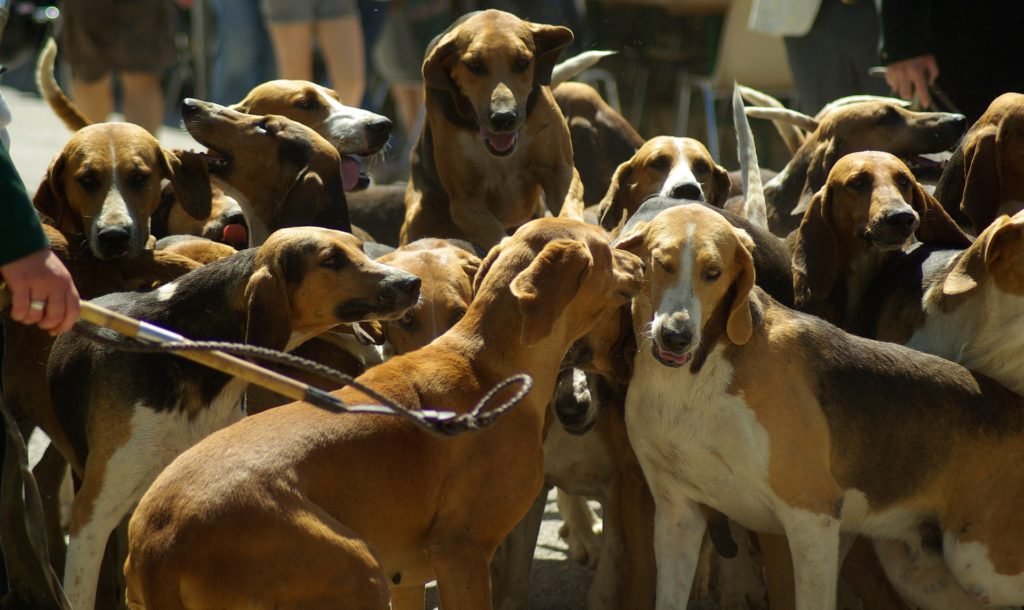
The Hounds have always been the biggest draw

From my bedroom it was always obvious that the hounds were the biggest draw with everyone including me wanting to get close to pet them even though they smelled rank due to the poor conditions they are kept under, something most of us were unaware of. They were noisy, boisterous, cheeky and naughty and appeared to be having a great time.

The horses were also a draw, but in hindsight it is difficult to understand why we all stood around, often in freezing weather, for an hour waiting for a group of red and black-coated horsemen and women to finish a morning drink outside a pub.
Hunting hounds, fox hunting, cruelty to dogs
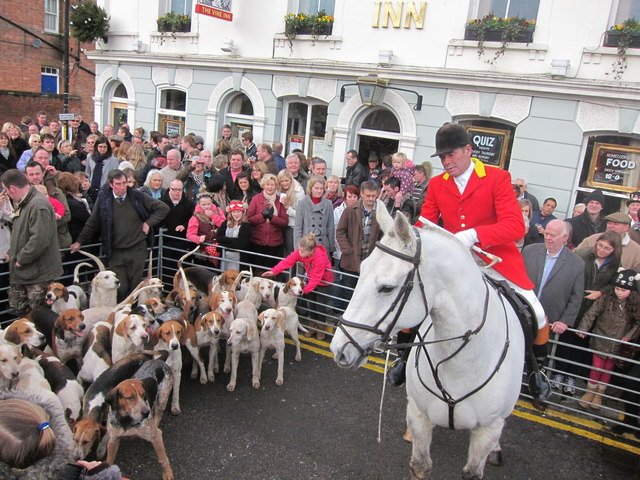
The hounds are usually the major draw for crowds at Boxing day Hunt meets.

Boxing Day hunts attract the crowds in ever-increasing numbers.

I no longer have any real association with Tenterden and rarely if ever visit because my father’s shop closed in the late eighties and both my parents have died, but the scenario shows that nothing has changed over the last four decades and despite all the campaigning and hunting ban we are even more happy to support such events despite what they stand for.

The Boxing Day Hunts are just a spectacle for most, but for hunt supporters they are an important way of keeping the debate in the public eye until that Nirvana in the future when hunting is legalised again.

Lets take the hounds out of the equation.

The law makers missed a golden opportunity to put an end to all this violence and mayhem towards both humans and animals on both sides of the debate. All that was needed was to make it illegal to participate in a drag hunt and to own, breed, keep or let loose packs of more than two dogs onto any land whether private or common for any purpose.

Arguments that the dogs (and horses) would all be killed as they are unsuitable as pets was always groundless as there will always be an animal lover on hand to devote their energies into saving them if required.

There is no reason why the meeting up of hunts cannot continue in order to maintain the postcard images and spectacle. There is no harm in allowing them to meet up outside a local village pub on horseback for a few drinks dressed in their red and black finery for the sightseers to clap and cheer as they ride off at the sound of the horns. They can still continue enjoy an exhilarating gallop across the countryside in search of wildlife, but let us dispense with the hound pack and drag hunting and the use of the poor creatures as bargaining chips to continue hunting.
Related Articles:

A tribute to the faithful war horses and their human comrades.

It is obvious from official war diaries that the men depended on the war horses as much as the horses depended on them.

My grandfather Edwin Clark was a ‘Driver‘ in the Canadian Field Artillery who sat on one of the six horses pulling the 18-pounder field guns and was responsible for looking their welfare. It was dangerous work as he and the horses had to pull the guns into the front line, unharness them and then take them back to relative safety a 1,000 yards to the rear where he looked after all their needs under shell fire.

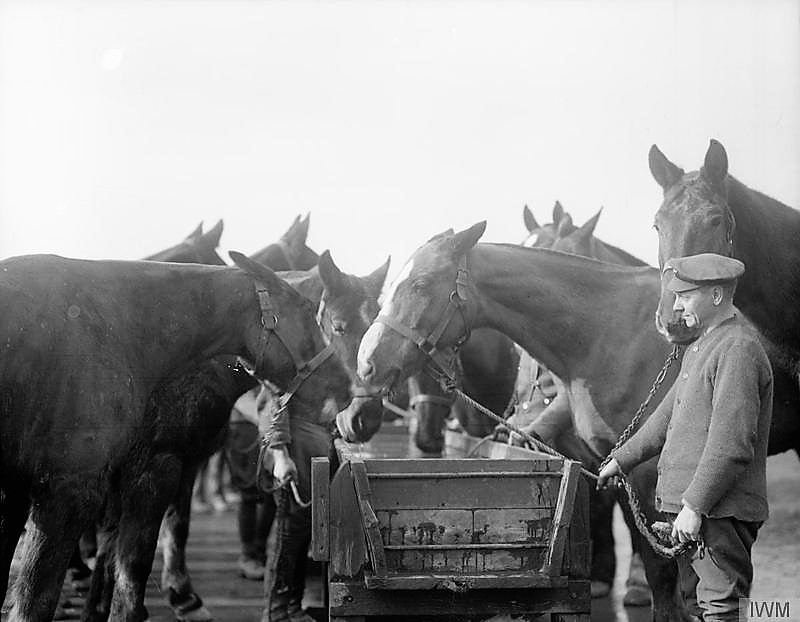
Despite all that the soldiers were going through the war horses were obviously loved and treated as comrades

He served in the same unit, the 4th. Division, 13th. Battery CFA throughout the war and the original War Diaries written up each evening by an officer of his Battery gave incredible descriptions and insights into the battles, the shelling, the casualties they suffered, the long marches and the conditions under which they fought.

What soon jumped out of the pages and gladdened me was that not only did they write about the state of the men and what they endured, but the diaries constantly mentioned their beloved horses and how they were suffering. It was obvious from the writings that it was generally believed by the men that they depended on the horses as much as the horses depended on them. They were in it together and just as the horses and mules did their utmost to help the troops the men reciprocated by doing all they could to ease their hardships. It is well known that the men formed strong bonds with their equine comrades.

Horses and mules were treated with affection

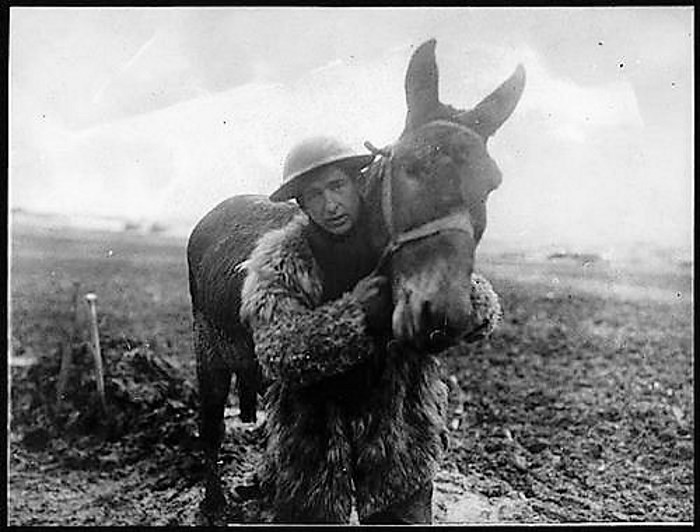
First World War mule and her handler.
“She is very stupid but I love her” – a soldier wrote this on the back of the photograph. Credit: National Museum of Scotland.

More horses and mules died of disease and exposure than from battle injuries and often it must have been impossible to give them adequate care. This is borne out by an officer who had to censor letters before they were sent, described how the men wrote home to their wives, girlfriends and mothers and gave examples of the care they took:

“Drivers often almost wept as they wrote of their faithful friends – the horses – wishing so much that they could be given more feed and better shelter. Such care and attention they gave these dumb animals. When nothing else was available an old sock was used to rub them down or to bandage a cracked heel, while breast collar and girth galls were eased by wrapping light articles around the harness to keep it from rubbing against the sore spot.”

It would seem that the men often ignored orders when it was detrimental to the horses’ welfare and on one occasion it is noted that following a long train journey the horses were unloaded and the drivers were ordered not to water them as there wasn’t time before a long march to the front. They ignored the order and watered and fed them anyway.

War horse, First world war, horse suffering
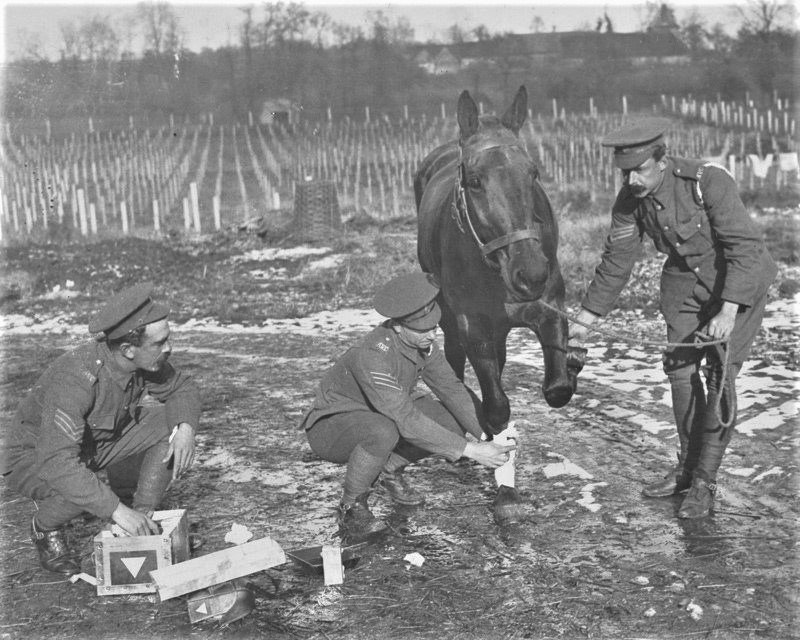
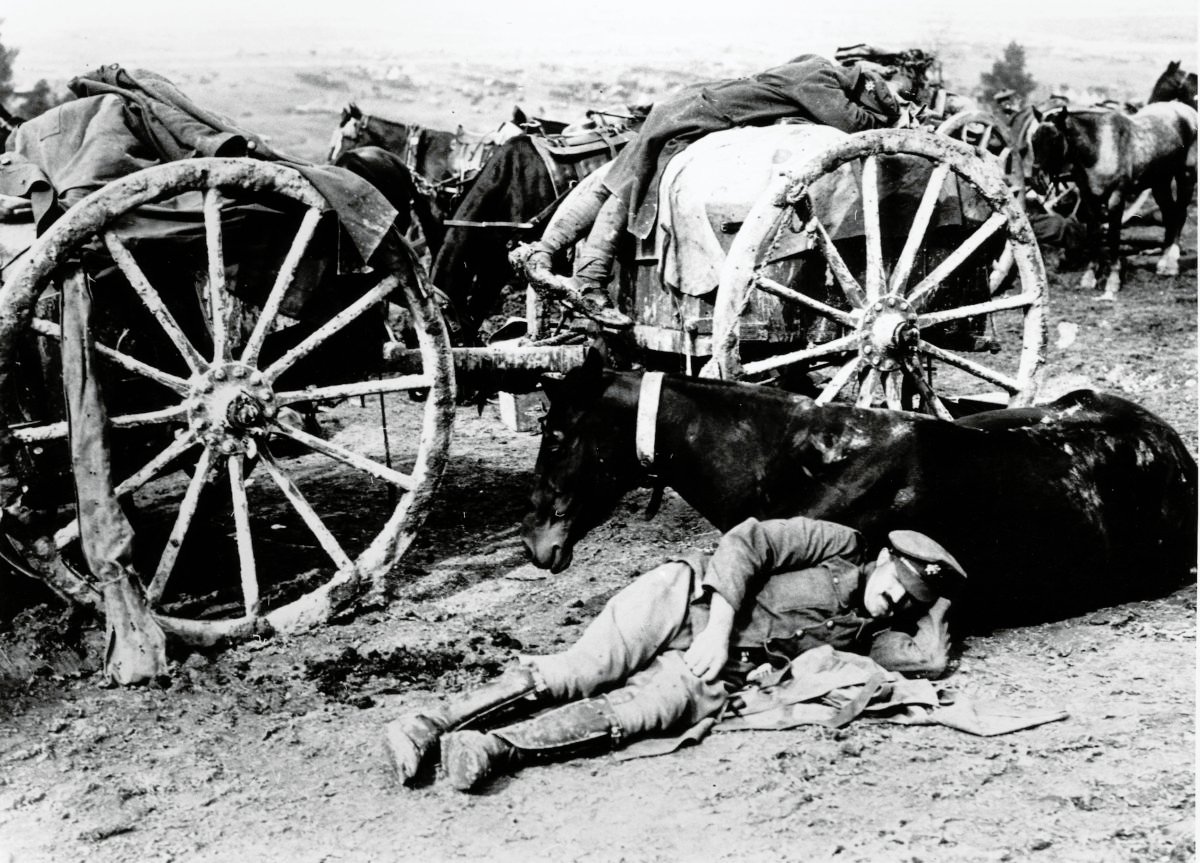
Soldiers were keen to do as much as they could for their horses’ welfare under terrible conditions. Credit Imperial War Museum.

Even the generals seemed to have affection and concern for them and found time to bring some humaneness among the horrors as hinted at in this extract about a General visiting the front in mid-winter:

“Our horses are in bad shape, but we are up to strength in guns. General Panet visited the Battery on the 11th. in the snow and saw horses wallowing in deep mud and immediately ordered them back to the lines declaring they were not to do more work for a few days”.

Even when issuing written orders thought was always given to ways of lessening the load and hardship of the horses and mules:

“There is a long march before any halt. It will therefore be necessary for Officers commanding batteries to pay the most scrupulous attention to every detail in connection with their horses. Riding on vehicles will be systemised [take turns] and the numbers riding thereon kept as low as possible. Guns and ammunition wagons are not to be loaded with unauthorised articles and throughout the march the condition of the horses must be ever in mind.”

War horse treated for wounds

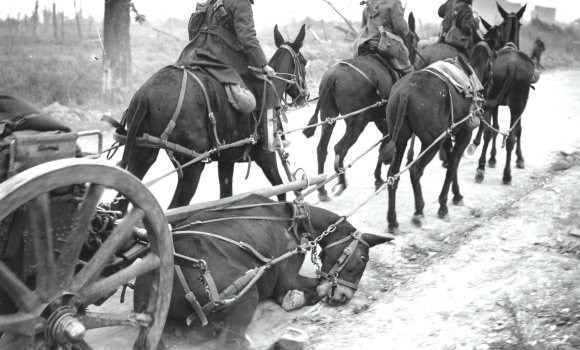
It was common practice to bomb the areas where the horses were kept

One officer lamented in the War Diary that “the road to the wagon lines is strewn with dead horses” and the the snowy and cold weather was having an effect on the horses”.  An insight into the terror caused to the horses is aptly described in this extract:

“the duty of the ‘stable pickets’ was an unenviable one, especially at night, when horse lines were being bombed or shelled. Quite apart from the danger of the explosions, there was always the chance of the picket ropes breaking and the horses stampeding. Horses frequently fought and kicked, becoming entangled in ropes and had to be followed and caught in the darkness”.

It was common practice to bomb the areas where the horses were kept as both sides realised the vital importance of them and my grandfather was badly wounded in such an attack. His 13th. Battery had just set up wagon-lines a few miles from the town of Raillencourt and were feeding the horses when the pilot of a plane literally dropped a load of bombs right onto the horses and men killing one driver and wounding nine other men including Edwin as well as wounding and killing many horses.

The scene was described as “chaotic with shrieks from both men and horses” particularly as the bombs had been a newly invented stick bomb that exploded a few inches from the ground throwing splinters of shrapnel all around. The shrapnel hit my grandfather in the upper thigh and he was taken back to England by ship for a month’s stay in hospital and luckily he didn’t have to return as the war ended.

War horse, war horse cruelty
More horses and mules died from disease, exhaustion and exposure than from enemy action.

For all the bad news it would appear that Christmas 1917 was a far happier time for the war horses in my grandfather’s Battery:

“The weather became colder and a light blanket of snow covered the ground. For the first time proper shelters were built for the horses, standings being laid with brick and soft stone from the ruins nearby, while iron sheeting was to serve as roofing and walls. Our horses soon showed the benefit of these precautions and by the constant care, losses and disease throughout the winter were practically nil”.

It is impossible for me to visualise or comprehend the carnage and horrors my grandfather must have witnessed to both humans and horses as it is the stuff of nightmares, but I like to think that my grandfather was a humane man and did all that he could to ease the suffering of the horses in his care. I also like to think that it was possibly  through him that I developed my soft spot for horses.

I wrote a book In remembrance of all the horses and men who suffered or perished in the Great War. orer a copy now:


Related Articles: