Abusing animals for entertainment is pure showmanship

Entertainment, Education or unnnecessary invasion of their space.

There is definitely a fine line between presenting an educational wildlife show or documentary and using such a programme or film as a vehicle to becoming a showman or celebrity. The late Steve Irwin alias the Crocodile Hunter achieved celebrity status and famously died under tragic circumstances.

Although much adored and respected his actions could be viewed as no different than a circus entertainer, just a showman whose antics publicised his zoo and gave totally the wrong impression on how animals should be treated and acted around. But this didn’t stop the media labeling him as a wildlife expert, conservationist, TV personality and all round good guy.

Provoking animals makes good television

He appeared to show little empathy towards animals but went out of his way to dominate them by provoking, taunting and aggravating them to get a reaction on the pretext of demonstrating their natural behaviour and this obviously made entertaining television rather than the animal just sitting and contemplating its surroundings.

Presenter, conservationist or pure showman.

Unfortunately for Steve Irwin he goaded or invaded the space of one animal too many and it took its revenge, or was it just reacting naturally to a threat. It was a needless tragedy brought about by unnecessary wish to show off and entertain. Such behaviour no doubt inspires other would be “showmen” or “he-men” to produce TV programmes and even encourage other people to act in the same way towards animals.

He-man of natural history.

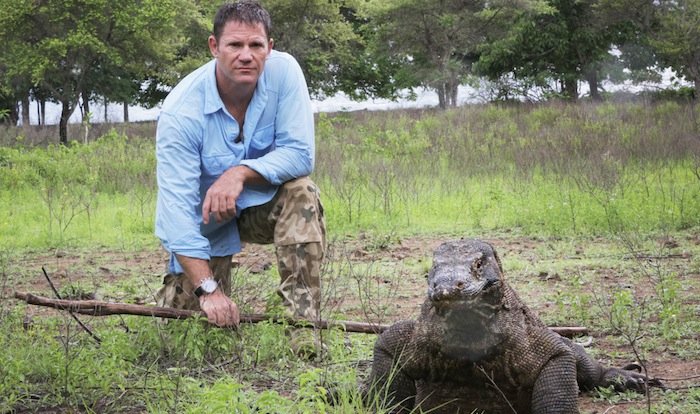
In the UK the Radio Times described Steve Backshall as the ‘he-man of natural history’ due to his ‘how close can I get and still walk away’ doctrine of approaching potentially lethal creatures in many of his TV series. His modus operandi involved tormenting and aggravating and goading them into a reaction.

There are many reality and pseudo-wildlife programs fronted by celebrities and heroic presenters which involve killing animals or stressing them and we even have extreme fishing whereby poor fish that have taken decades to grow to an enormous size are depicted as “monsters”, hunted down, caught and killed just for perverse entertainment.

Killing a caiman on Bear Grylls TV entertainment programme The Island. Channel 4.

Such programs have unfortunately become very popular because we seem drawn to these personalities treating them almost as heroes and we do not question whether their actions and methods are benefiting the animals they are ‘presenting’.

David Attenborough critical of killing animals for entertainment.

David Attenborough recently criticised Bear Grylls for killing animals for entertainment on his reality shows. So-called celebrities were encouraged to unnecessarily kill animals to “survive” in the name of charity to prove some inane survival point. David Attenborough was quoted as stating “we’ve never killed an animal [in a film]. Bear Grylls will have to answer for himself”.

The presenter also came under fire in 2016 when a so-called reality star killed a crocodile by stabbing it in the neck. Animal rights supporters argued that the crocodile was not killed humanely and that it was done purely for ‘entertainment’, was unnecessary, and sent out the wrong message about the status and use of animals. More recently he was accused of exploiting animals for greed by opening a shark attraction and criticised for promoting the use of snares in his Bear Grylls Survival Guide which was withdrawn from sale.

It may all be good television, as reptiles and fish are notoriously difficult to encourage to put on a good show, but surely it is unnecessary and only promotes the doctrine that it is OK to view animals as objects to dominate and subjugate, tease and provoke and even kill without compunction – not really the ideal impression to give young people.

Those involved argue that it is educational  in trying to prove their natural behaviour and animals are not “harmed”, but most wildlife documentaries seem able to do this without such unnatural interference. Now that we have the technology to produce such wonderful wildlife and nature documentaries such as the Blue Planet is it not time for such archaic television presenting to be consigned to history?
Why Commercial Whaling was never really banned.

Post updated July 2020

whales, whale hunting, whaling ban, whaling moratorium

On the  1st. July, 2019 Japan announced it was beginning commercial whaling again causing worldwide outrage and accusations of illegality. But tragically they had every right to do so as they had formally withdrawn from the international agreement not to hunt. The so called moratorium was only ever a gentleman’s agreement and a trade bargain. In June 2020 the whaling fleet returned from its first hunt with the frozen meat of 237 whales and plans to increase hunting in the future. So how is this possible?

Agreement only intended to preserve stock for future hunting

Most large species of whale were nearly hunted to extinction during the first half of the 20th. Century which resulted in 1946 with the signing of the  Convention for the Regulation of Whaling by the major whaling nations, not for the rights of the whales but to “provide for the proper conservation of whale stocks and thus make possible the orderly development of the whaling industry“. Whaling has continued since the ban under a quota system “confined to those species best able to sustain exploitation to give an interval for recovery”. Their ideal has always been to properly regulate whale stocks to maintain enough to capture without endangering them as a natural resource.

The International Whaling Commission (IWC) was set up under the  Convention and the members meet every two years to decide which species can be hunted, how many and by who and various other policy issues. Any country can join regardless of whether they want to hunt whales or not and each member has voting rights.

This system did not work very well and countries continued to whale pretty much unhindered which resulted in organisations like Greenpeace literally putting themselves between the whales and whaling ships while hundreds of campaigners devoted years during the 1970’s and early 80’s attempting to bring whaling to a complete halt by lobbying and pressuring various countries to vote for a total halt on commercial whaling.

This was extremely difficult because the whaling nations were not agreeable to interference in their traditional and lucrative industry, but finally a vote taken in 1986 placed a moratorium on commercial whaling of vulnerable species like Humpback, but still allowed hunting of smaller species. Iceland and Norway objected to the moratorium and Norway withdrew in 1993, while Japan and Iceland continue hunting whales under the guise of “scientific research”, and many nations still try to over turn the ban.

Whaling, illegal whaling, IWC,Commercial whaling ban,whaling moratorium

The ban was greeted as a great  victory by campaigners which it was, as instead of tens of thousands being killed each year the number is now a few thousand per year. Unfortunately the moratorium was never a complete ban as hidden in the Convention is a “get out” clause which states that any country could  begin commercial whaling by just withdrawing from the IWC Convention. And this is exactly what Japan did.

Any member country of the Convention can just opt out

Article XI of the Convention allows any member Government to withdraw from the agreement on the 30th. June of any year by giving notice before the 1st. January of the same year. Although not morally responsible it is legal. There was a worry that other countries would follow Japan’s lead and pull out, but this does not appear to be happening.

Astrid Fuchs of Whale and Dolphin Conservation (WDC) stated that Japan’s action may “encourage other countries to quit IWC”. There were rumours that South Korea had an increasing taste for whale meat and officials were worried they will soon follow.

Many countries claim an exemption and receive a quota for their “aboriginal” inhabitants to hunt small numbers of small whales for their own needs, but many of these now want to increase their hunting to sell the by-products. Countries which presently hunt whales in one form or another are Japan, Norway, Iceland, Denmark, Russia, USA, St. Vincent and Grenadines, South Korea and Greenland.

Japan has never agreed with the moratorium

Why has Japan done it? Well they have tried every trick in the book to continue whaling since the moratorium came into force including using the loophole all countries have of catching whales for “scientific purposes”. Japan has also allegedly been catching more than its allowed quota of Minke whales for years and trying to persuade member countries to support a vote on their proposal of “small type commercial whaling” (STCW) using small whaling ships in territorial waters.

At one point they were involved in a scandal when they were accused of allegedly bribing countries (mainly African and other poor countries none of which whale hunt) with aid and resources if they joined the IWC and voted with them to overturn the ban on commercial whaling permanently. They almost succeeded in doing so. The decision to leave the IWC wass no doubt a result of their frustration at all their efforts being thwarted.

I have been lucky enough to have had many close encounters with whales in many parts of the world and they truly justify being described by the overused term awesome. If you have never been whale watching make it the top of your bucket list and I defy anyone not to be emotionally affected by the experience. We need these unassuming, helpless and magnificent creatures in our world and they still need our support.

Organisations which campaign against whaling and try to protect whales include:

Whale and Dolphin Conservation

Sea Shepherd Organisation

Greenpeace

World Wildlife Fund