The RSPCA are in the process of closing some of their animal shelters, hospitals and clinics and allegedly making at least ten percent of their administration and front line staff redundant according to Society statements and media reports. This has obviously caused alarm and distress to their staff and several Change.org petitions have been started which are already attracting many signatures. It could be viewed as a knee jerk reaction to the present financial climate caused by the pandemic, but it could be just an opportune time to restructure the charity once again.
We seem to have a love hate relationship with the RSPCA, as many do with the Police, and there will always be sections of society and organisations happy to criticise and who want to reign them in but in the interests of all the abused animals of England and Wales we cannot do without them. This is because they are the only agency or charity actively trying to prevent abuse before it happens and taking 0ver 90% of all animal cruelty prosecutions.
RSPCA have always been evolving and restructuring
The RSPCA throughout its history, and particularly in the last fifty years, has always adapted to changing society needs, circumstances and attitudes whether financial or not. I have been involved with the Society on and off since 1970 and have seen it all before. Back then there was only one hospital and that was a converted house, the only animal shelters within striking distance of London were the Mayhew Home and Southall cattery.
At the end of the sixties the Society still owned hundreds of houses in which their inspectors lived, answered their own phones, organised there own day, were part of the community, had kennels and cages in the back garden to temporarily hold animals and were virtually on 24 hour call. Then to meet financial and changing society needs they were all sold, call centres were introduced and the inspectorate was regionalised.
Throughout the seventies they closed dozens of “one man clinics” in the poorer areas of London like the east end, south and north London or like the Mayhew Home transferred them to other charities. They closed their central night emergency service to much outcry that had provided vital rescue and treatment services during the city’s impoverished decades. Even their grand headquarters building in Jermyn Street was closed, sold and demolished when the Society relocated to the countryside.
In the next few decades they continued to adapt their services introducing animal collection drivers and animal welfare officers to take some of the workload off inspectors. The Society and its Branch animal shelters took fewer unwanted pets from owners and concentrated on homing those animals seized or collected by their staff. The Society has always changed to meet present demands.
The RSPCA sometimes loses sight of its roots
Along the way no doubt the Society has made mistakes particularly when they have lost sight of their roots and core objectives and insisted on establishing a department for everything connected with animal welfare rather than concentrating on what they do best. It seems they are beginning to realise this and are leaving certain aspects to the dozens of other charities who carry out similar work such as the Cats Protection and Dogs Trust who rehome animals and those that treat animals of the poor like the PDSA and Blue Cross. The RSPCA fulfills a unique and important role that no other charity dares to get involved in and that is protecting and preventing animals from ill-treatment and they must concentrate on this.
It is always terrible for people to lose their livelihood and the work they thoroughly enjoy and believe in but unfortunately times and circumstances change. But hopefully the Society will in the future avoid decreasing their front line activities as without adequate services more animals will undoubtedly suffer. They have always managed to survive controversy, criticism, upturns and downturns and they hopefully they will continue to do so because there are so many animals out there that depend on them.
A tribute to a Bahamian rescue dog named Condor who kept me safe and sane.
Condor died forty years ago but I have never forgotten her. [John Brookland 1976]
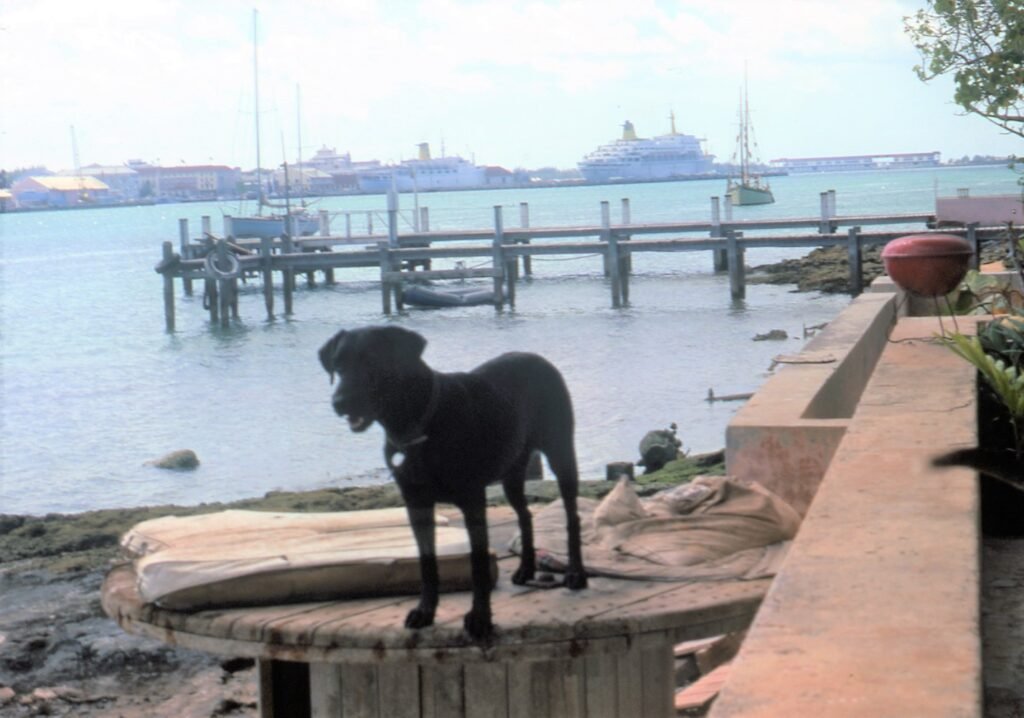
In September 1975 and I found myself sitting in a bungalow beside the Bahamas Humane Society compound in Nassau having just arrived on an arduous flight from the UK to take up the position of chief inspector. I was exhausted and full of misgiving as to whether I was up to the task.
At this point the back door was pushed open and I heard the tapping of nails on the tiled floor and a sleek black female padded nonchalantly into the sitting room. She had the appearance of a crossbreed black Labrador, but had a three-inch excuse for a tail probably nipped off when a puppy. Strangely no owner appeared behind her.
She stood in the doorway staring at me with sorrowful eyes for a few seconds and then flopped onto the cool tiled floor and made herself comfortable. There was no attempt to come over and introduce herself, but it was obvious I was being thoroughly scrutinised as though a great decision was being made. I watched her and she stared at me and from that moment on she never left my side during my stay and a special relationship was born.
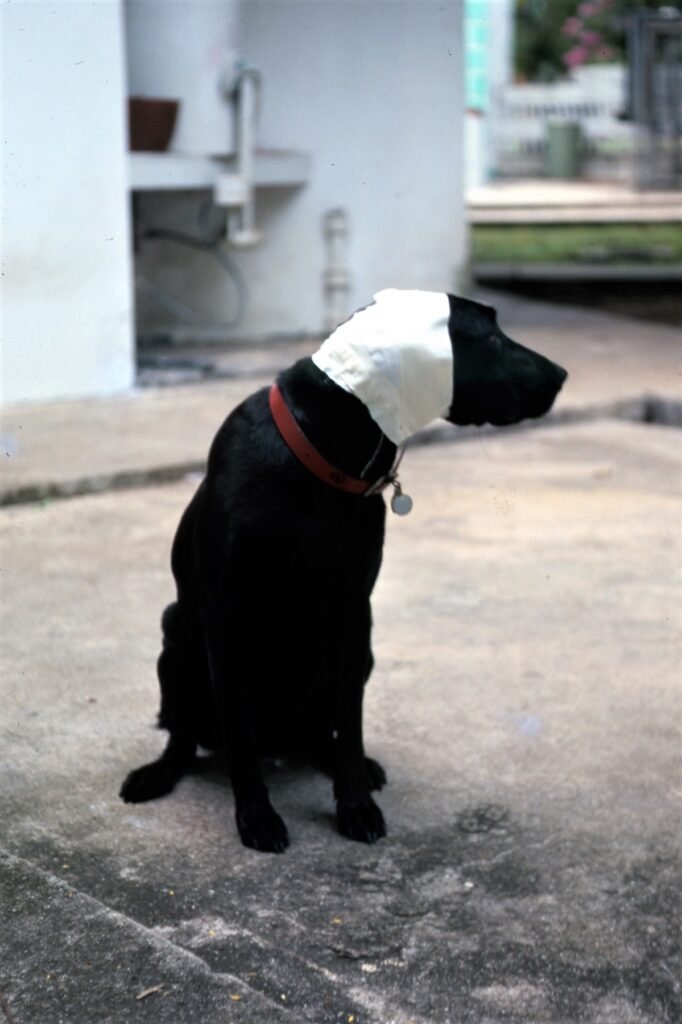
Her guilty look – I always knew when she had done something wrong. [Photo: John Brookland 1977]
It was only our first date but she stayed the night.
I had no idea where she had appeared from, but I was glad of her company and although it was only our first date, she stayed the night lying across the doorway to the bedroom as though instinctively on guard. It proved to be a case of role reversal with her adopting me rather than the other way round.
I discovered next day that her name was Condor and that she was technically one of the “yard dogs”. It seemed though that she was a lady quick to take advantage of a situation when the fancy took her, and possibly spotted a relationship with good prospects. Wherever I went she became my permanent shadow, and she became my friend, soul mate and protector. She came out on all my work visits and social visits (she hated missing a party) and she was also very vain always finding a way of muscling into a photograph.
But when she stared at me with her sorrowful eyes I could forgive her anything.
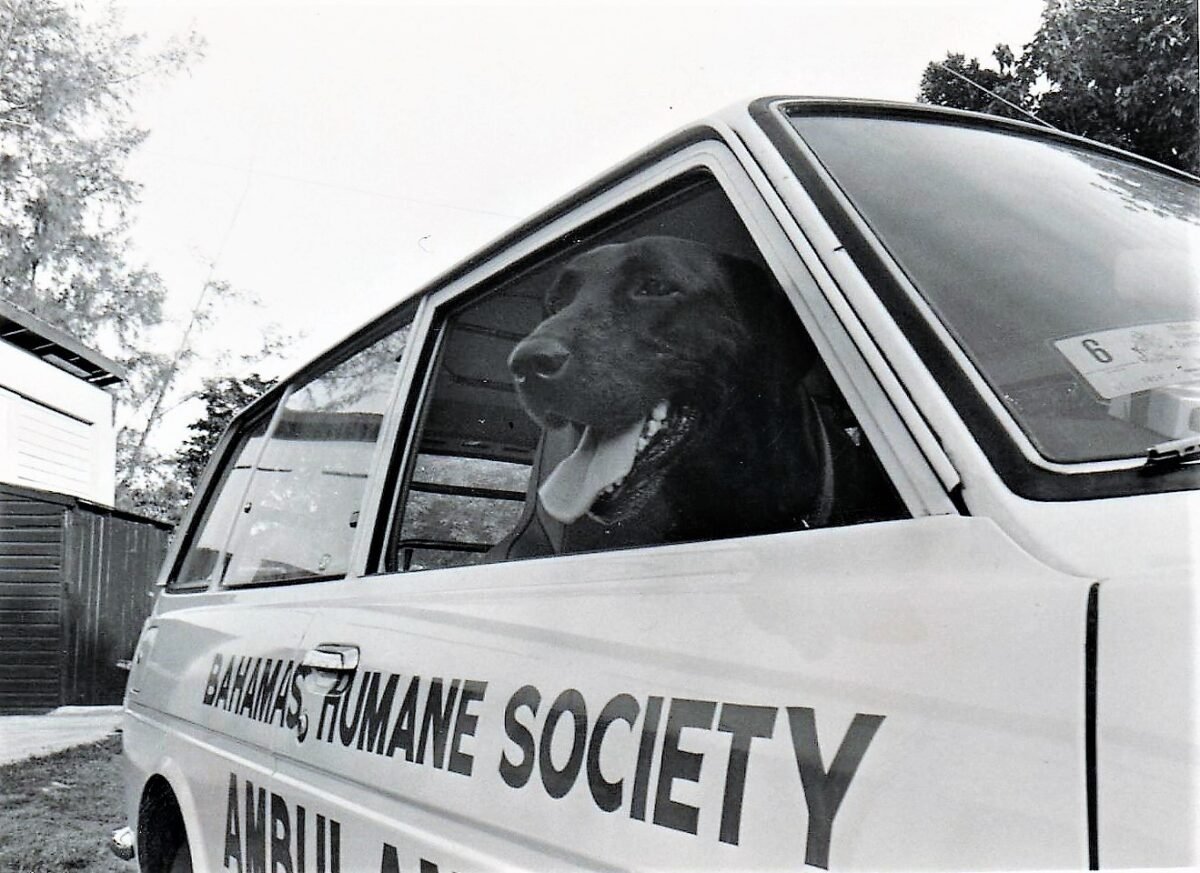
We enjoyed patrolling the island attending incidents and stopping off at local villages to chat to residents about their complaints and worries over animals. Being a typical dog she adored hanging her head out of the passenger window and children would wave to her. She was good with them and they enjoyed meeting her giving me a chance to talk about animal welfare. When we sped to emergencies sometimes with the blue light flashing, Condor loved to lean into corners as we careered round them which always made me smile. (I was also a district constable in the Royal Bahamian Police Force (RBPF) so allowed to do it!).
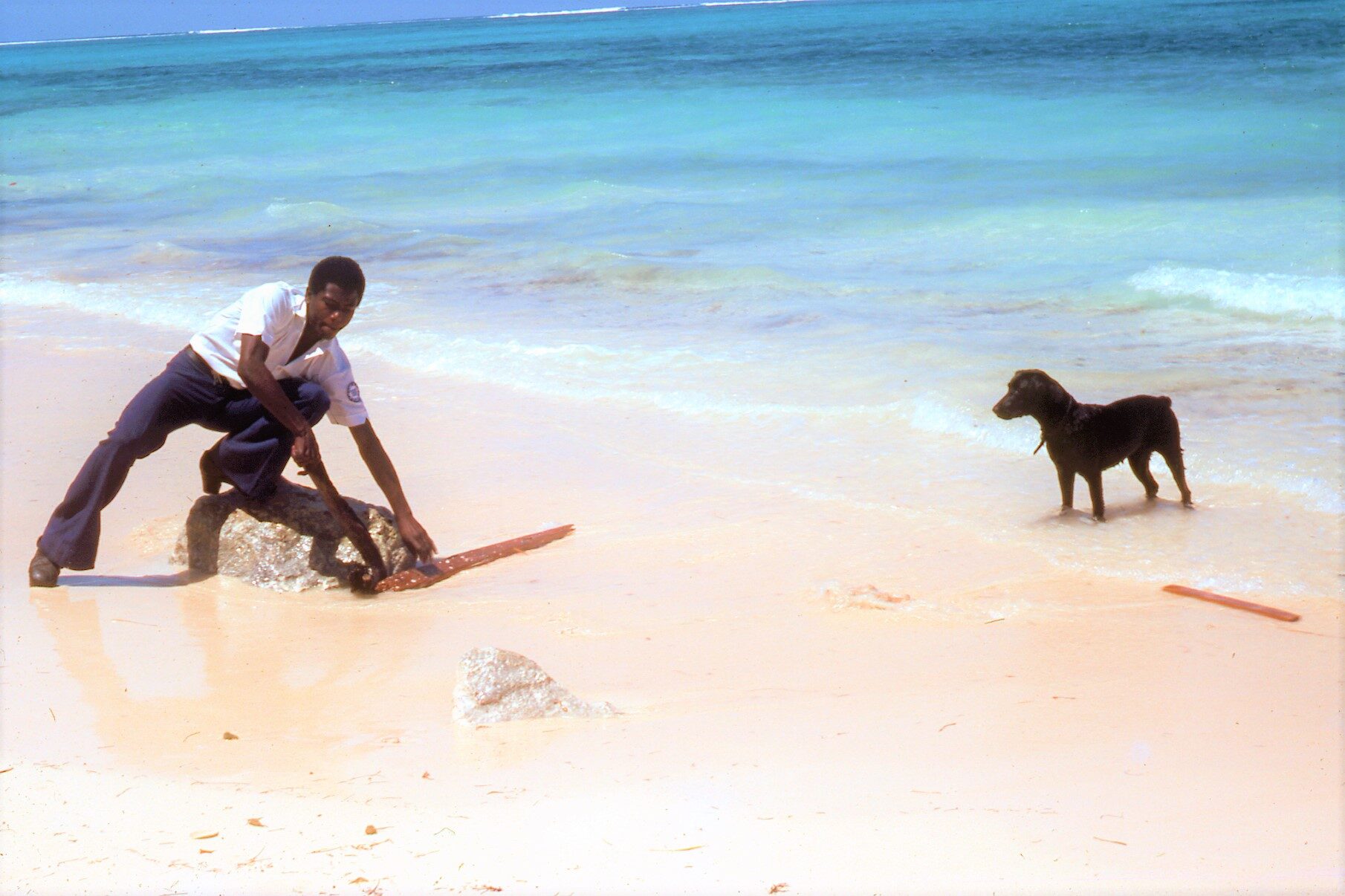
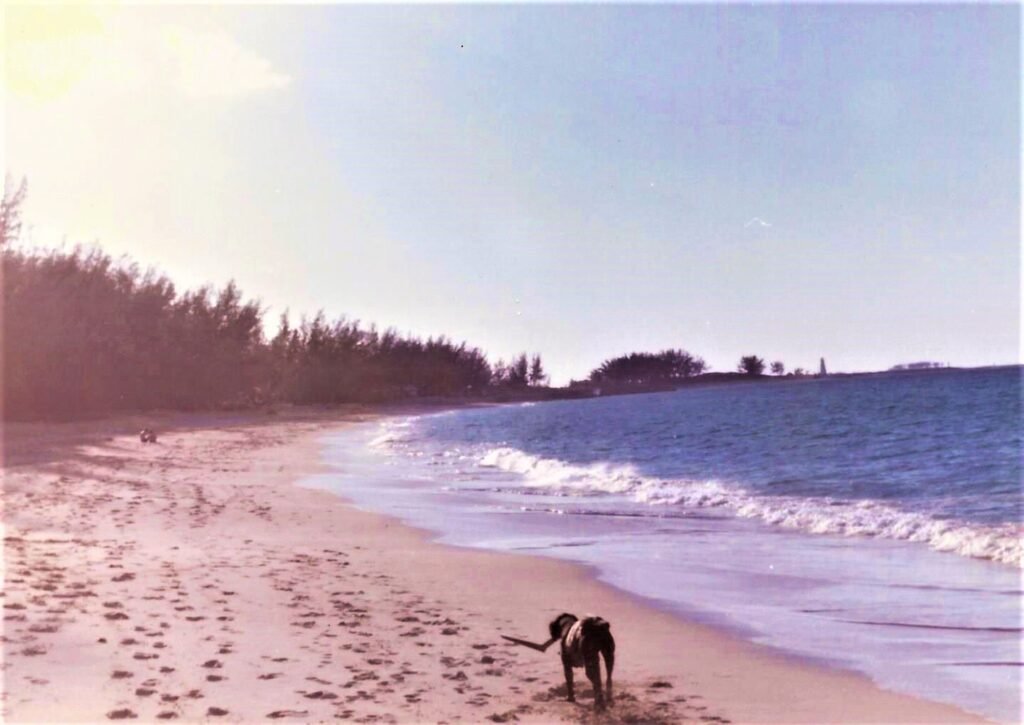
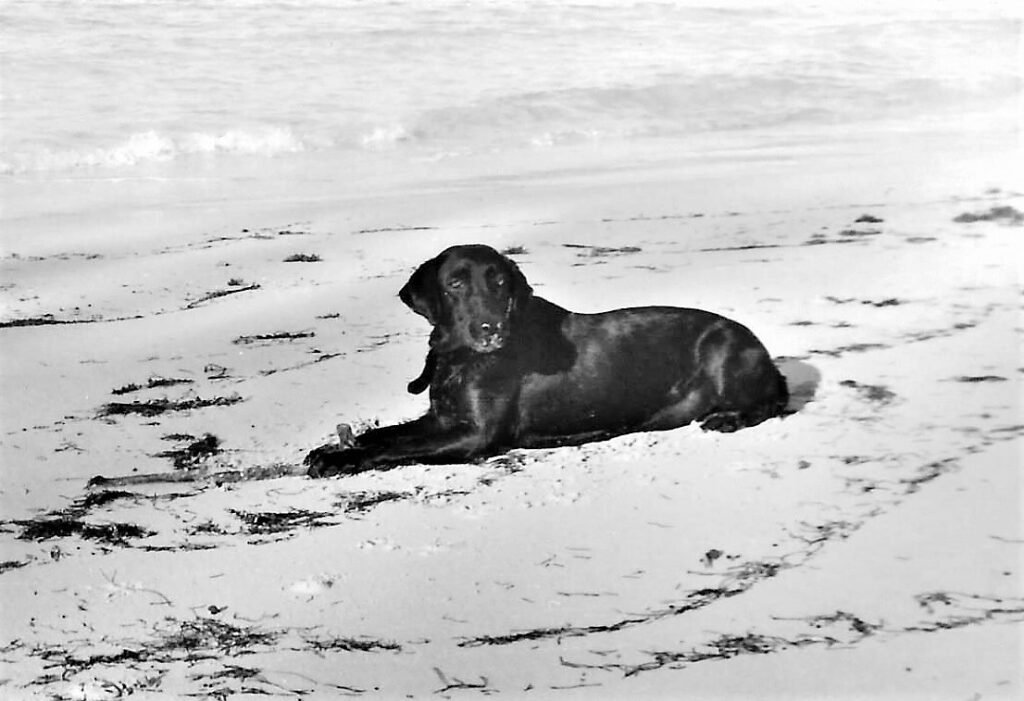
Waiting for Kirk Glinton, my assistant Inspector to throw some driftwood during a rest on one of our patrols.
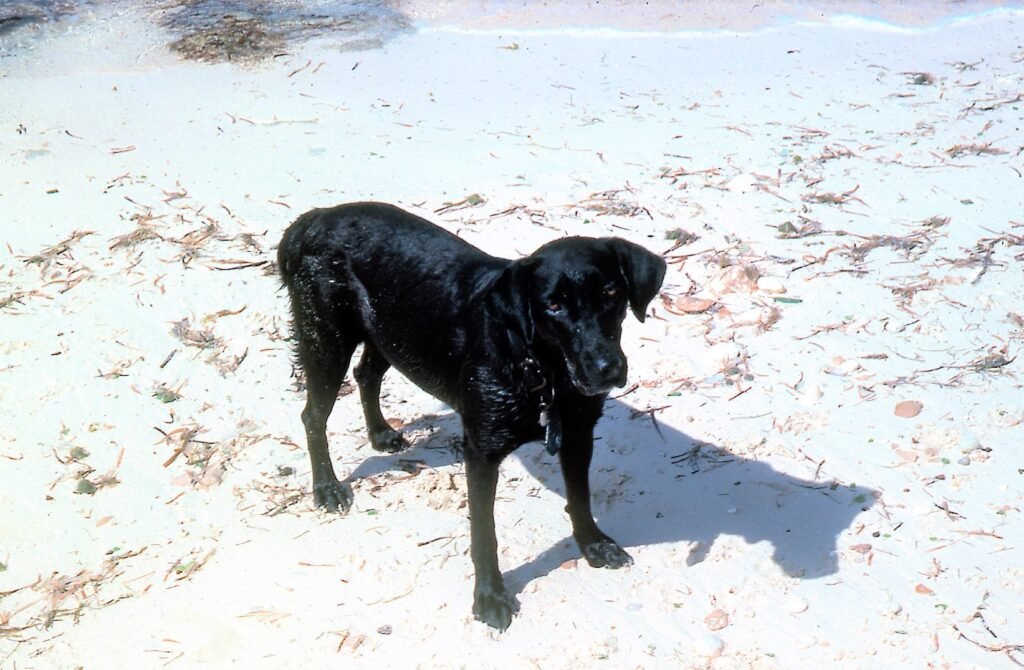
I often stopped at a sheltered deserted beach and allowed her to swim as she loved the sea, a true water dog, but it played havoc with her ears resulting in regular ear infections and irritations which I had to treat, but I didn’t have the heart to ruin her fun.
The sea water played havoc with her ears. [Photo: John Brookland 1977]
Condor loved our downtime weekly trips to Paradise Island beach.
We both enjoyed our downtime together particularly my weekly afternoon off when we usually went to the western end of Paradise Island beach which in the 1970’s was often deserted (no Atlantis, Club Med or marina at that time). We swam and snorkelled, finishing the day with a stroll to the lighthouse and back when she would trot in front with a piece of driftwood firmly lodged in her mouth. I enjoyed snorkelling but Condor had difficulty understanding the concept and all I could ever see was her four legs thrashing back and forth in front of me often ramming me and tipping me over. It was a time to escape all the stress and trauma of my challenging work for a while and it was extremely idyllic.
I enjoyed our walks on deserted Paradise island beach with her in the lead, a piece of driftwood firmly grasped in her mouth. [Photo: John Brookland 1976]
Her stomach would bloat to the size of a beach ball.
She did come with many bad habits including severe flatulence mainly caused by pigging any food material she came across either fresh or decomposing. Her stomach would often worryingly bloat to the size of a beach ball to the point of exploding and she would lie on a cold floor moaning. My long-suffering friends, when I was invited to dinner parties were very tolerant of the occasional stench emanating from wherever she lay, and to their credit carried on conversing without pause.
She also loved to roll in horse manure and as I spent a lot of time dealing with abandoned and ill-treated horses, she had plenty of opportunity. When I shouted to stop she would always accept the scolding in good spirit and carry on.
Condor particularly loved speeding to emergencies sometimes with our blue light flashing.
Condor would stand on your groin until you gave her the window seat.
We had three vehicles of which two were Volkswagens with bench seats and obviously Condor always wanted the window seat which wasn’t a problem unless I had a colleague with me. Then there was a lot of pushing and jostling to make her sit in the middle of us but she would soon lean heavily against you or lean over and drool while standing painfully on your groin until you gave way. Then with the seating arrangements organised we could start the day.
My work occasionally got me into sticky situations when I was threatened with a cutlass, broken bottle or some form of aggression, but the presence of growling Condor and the implied threat of letting her out of the vehicle often had a calming effect on the situation. I would never have put her in danger, but I discovered there was a form of black dog syndrome on the island and having her as a sidekick gave me confidence and prevented me from possible harm on several occasions.
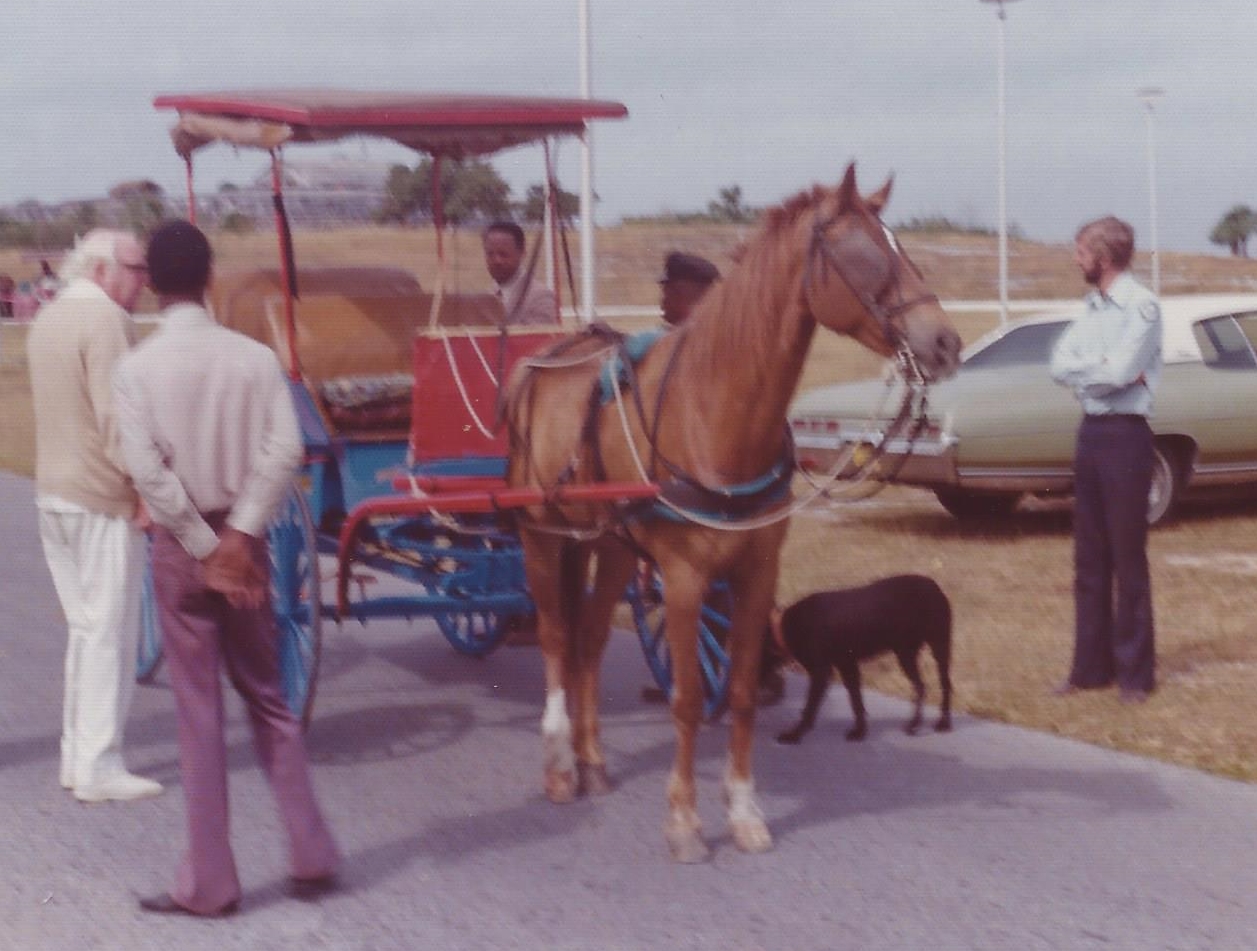
Condor helps me to inspect the tourist surrey horses with the Government Vet and officials obviously concerned about the state of the wheel. Fort Charlotte 1976
Condor keeps me sane.
She was also adept at emotional support and near the end of my tenure the emotional and physical strain of work overload and the stress of dealing with all the abject cruelty reduced me to a state of depression and one evening I just went out and started walking down the road in a daze not knowing where I was going or even caring. A concerned Condor tagged along as always and I eventfully found myself sitting on a deserted Saunders beach a mile or so from home having a good cry with Condor leaning against me.
She did her best to cheer me up without success so she sauntered to the waters edge, grabbed a piece of wood, came back and threw it at my feet. She returned to the water and barked encouragingly until I got up, smiled and started playing. For some reason my mood immediately lifted. It was as though she was telling me that life was just a beach so forget everything else and let’s get on with it and we did. I think having her with me saved my sanity that evening.
She always had to be first into the ambulance. [Photo: John Brookland 1977]
Not long after this incident I was offered a job back in the UK and decided for the sake of my sanity I could not pass it up. Immediately my concern was what to do about Condor. I cannot explain how reliant and emotionally connected I was to her at that juncture and to leave her behind was unthinkable as I owed her so much.
Quarantine had just been introduced in the UK under new Rabies Laws and I knew she would have to undergo six months solitary confinement in a kennel which would probably be purgatory for a dog accustomed to so much freedom. She was not a young dog and I wasn’t sure it would be fair to take it all away from her, but I didn’t think I could give her up so I started applying for the required import license and quarantine space.
The Society veterinarian, Doc Watson, volunteered to do all the necessary tests for her health certificate and this was when I received the devastating news that she was suffering from the latter stages of heartworm. He advised that it would be unfair and selfish to put her through such a traumatic journey and change of lifestyle when her days were numbered. I was heartbroken making the terrible decision to leave her behind, but everyone at the Humane Society promised to care for her.
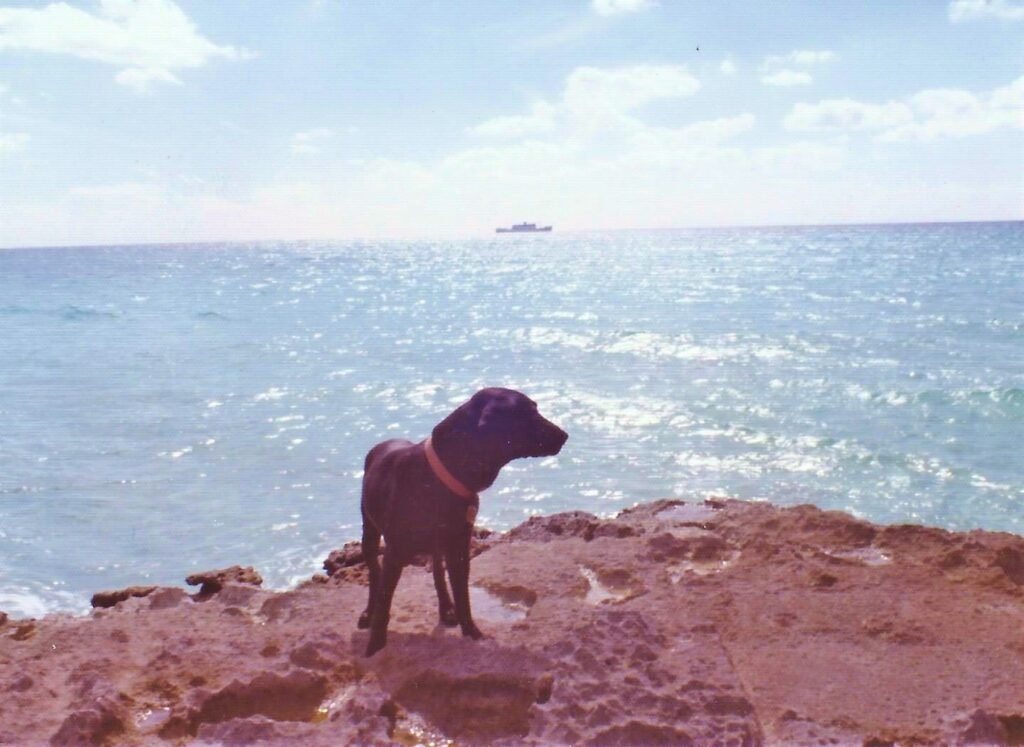
How I like to remember her -for Condor life was just a beach.
I shall never forget my day of departure when she trotted out to the car with me and sat by my side with an enquiring look. I had tried to say my last emotional goodbyes to her in my house but I gave her a last cuddle. As we drove away, I looked back to see her sitting in the middle of the car park with a resigned look on her face and I was absolutely devastated and full of guilt.
Postscript.
Condor survived another eighteen months and I kept in touch and was informed that she soon settled back into her old routine. I did see her again on a return visit a year later but kept my distance and I was pleased to see that she appeared happy with life. She was an amazing dog and I still mention her all the time, particularly when I see a black Labrador with a red collar on a beach, which is often.
John Brookland worked for the Bahamas Humane Society from 1975-77 during which time he had to deal with almost overwhelming instances of animal cruelty and suffering. The Society still battles to help the animals of New Providence island.