
How to Avoid Being a Thoughtless Dog Owner

Tips on how to be more sensitive to your dog’s needs.

Dogs will put up with virtually anything we throw at them because throughout time they have been groomed to be our subservient companions, existing to please us and to be completely dependent on us, but in many cases we do not reciprocate this devotion. We often let them down by insisting they comply with our lifestyles and leisure pursuits rather than considering what their desires and needs might be for a life worth living. Many of the activities we think they enjoy is purely subjective on our part, as of course they cannot tell us otherwise. Companionship is a two way street and what they need is someone to spend quality time with them, doing things they want to do not necessarily what we want them to do.

Some points to consider from a dog’s point of view:

1. Don’t acquire me intending to leave me home alone.

Recent surveys indicate that 40% of owners leave their dogs home alone for more than seven hours and more worryingly 20% thought it was acceptable to leave a dog for more than a day. The whole point of having a companion pet is for its company and to spend as much time as possible with it. Many dogs suffer from depression caused by separation anxiety with symptoms ranging from incessant barking, whining, messing and destroying furniture and fittings to just sitting and staring awaiting an owner’s return. It is not enough to spy on your dog with a cctv camera or leave the TV or radio on. You should be at home with it.

2. Don’t take me to a crowded shopping mall or market.

Before considering taking your pet to the boring sterile environment of a crowded shopping mall try seeing it from their point of view particularly if you have a small breed. Give it a try by getting on your knees and elbows continually dodging from side to side for hours through sea of alien legs and see how you get on. Not to mention negotiating the slippery tiled floors and the frustration of these sterile surroundings devoid of animal scents to investigate and the perfect spot to make a mark on things. It is stressful and unfair to enforce such a boring trip on a dog and don’t even think about leaving the dog in the car.

3. Don’t tie me up outside a shop or supermarket.

Ever watched the behaviour of a dog tied up outside a shop. The look of bewilderment as the owner disappears inside and the hesitant tug at the lead followed by the anxious and apprehensive look at the strangers who walk back and forth or try to engage with it. Then as the minutes tick by the nervous pacing and stressful occasional whine and bark at the realisation that you may not be coming back. Finally the elation and relief when it spots your familiar face which you mistake for an demonstration that your dog loves and misses you, when it is in fact sheer relief on its part, having gone through a whole gambit of stressful emotions no matter how many times you insist on putting your dog through it.

4. Don’t take me jogging or running

Just because dogs like to run, and agreed some are more suited to running a reasonable distance than others, it doesn’t necessarily mean they particularly enjoy long distance or training runs. Dogs will valiantly follow because their life revolves around pleasing us, but long distance running is not natural for them. They were bred for companionship not to take part in our extreme sports and pursuits. Keeping up can cause emotional and physical distress when they wish to stop for a rest, a good old sniff or comfort break. Churlishly shouting at the dog to keep up, or worse still, strapping the dog to you so it has no choice is just being purely selfish. Better to find a human buddy or join one of the numerous running groups, and entertain your dog later. Remember your obsession to run may not be theirs.

Whether all dogs enjoy our pursuits is subjective on our part.

5. Don’t go cycling with me in tow.

As with running, cycling with a dog in tow either for sport, exercise or pastime is another selfish practice with little thought given to the interests of the dog. The enjoyment factor for the dog is purely subjective on our part and it is better to err on the presumption that the dog does not necessarily like being dragged behind a bike. Thanks to social media coverage we now have Canicross and similar “sports” and just because the pet trade have cashed in by providing attachments to harness one, two or three dogs to the rear, side or front of the bike it doesn’t make it either sensible or acceptable. It is neither safe for you, the dog or passing pedestrians. It is no wonder that there are reports of members of the public becoming aggressive to cyclists doing this. Shouting at the dog to make it keep up should they falter is particularly shameful.
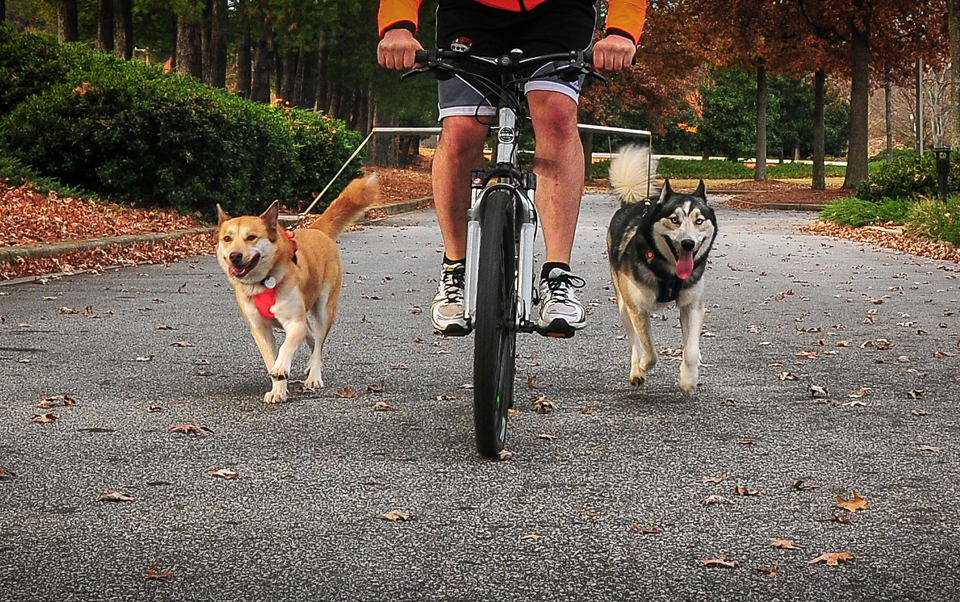
cyclist pulling dogs

6. When on a walk with me leave your mobile phone or headphones at home.

For most dogs their daily walk(s) is the highlight of their day, their chance for a fun time, to play, explore and receive words of encouragement. The whole purpose of taking your dog for a walk is for you to have one on one interaction, form close bonds and get some fresh air and exercise for our well being. It should not be a chore, or to spend time catching up with friends on the telephone, texting, searching the net or listening to music. Remember your faithful friend is only with you for 8 to 15 years so make the most of it.

7. Don’t mock your dog.

Although dogs can be very intuitive to our moods and actions they may not always pick up on our motives when we play and interact with them. There is a fine line between innocently playing with them and mocking them through teasing, taunting and ridiculing them. Dogs can pick up on this resulting in them feeling frustrated, upset, worried and even depressed. There are many actions that can cause this including feigning throwing a ball or stick, not allowing them to have a good sniff or pee on a walk, teasing and winding them up so as they get over excited and then admonishing them, being impatient with them, tugging their lead, dressing them up and laughing at them. These are all things that can confuse and frustrate a dog and show a lack of sensitivity on our part.


Related Article & Video:

A video about changing our mindset on our selfish insistence on making our dogs fit in with our lifestyles.

What has religion ever done for animals.

Religion has not been a great friend of animals.

Granted, Noah did allegedly save quite a few of them on his ark, but apart from that what has theology ever done for their welfare and rights? Religious creeds and their interpretations have throughout history deeply ingrained our belief that we have total dominion over animals to do as we want. It is one of the few beliefs that all religions seem to share and back in the day when religion was of more relevance and widely followed, it entrenched our attitudes towards animals and how we should treat them continuing right up to the present day. Prior to this many ancient civilisations revered them and had looked upon them as gods with souls and powers.

Beings without mind, reason, souls or status.

Religious attitudes to animals is a complex subject with each religion having its own take on the position of animals in society which varies considerably from culture to culture around the world. Mostly though, all animals have been thought to be beings without mind, reason, immortal soul or moral status, with the emphasis on man being more special to God than non-humans. History is littered with ancient sages, philosophers and theologists who have interpreted the teachings of various religions and set the standards by which we view and should treat them. Generally, theology has not been a great friend to animals.

In the ancient Middle East, the cradle of western culture, the domestication of animals resulted in them having to be debased to elevate human beings above them. Prior to this, ancient civilisations had looked upon many animals as gods and deities. Although the common theme amongst most religions is that they should be shown respect and compassion, they still do not deserve any rights.

Their life and death subject to our use.

Western beliefs were heavily influenced by Christianity which has always maintained that they were put on earth to serve human beings and as St Augustine put it: “by a most just ordinance of the Creator, both animals’ life and their death are subjects to our use”. Most original versions of the Bible gave humans “dominion” over all living creatures with some christian faiths going as far as to tell their followers to “rule over every living thing, multiply and fill the earth and subdue it”.  

Religion

The Christian Bible has an unfortunate habit of describing them as beasts and is all for going out and killing them, even spreading fear and dread on them. The Christian tradition supported the ideological justification for the abuse of animals right up until the 19th century, when conversely certain Christians started animal welfare charities.

Eastern religion more benevolent.

On the other hand, most Asian or Eastern religions appear to have a more benevolent attitude towards them, if not always so in practice, believing that a human soul could pass into the body of an animal or even that we could be reincarnated as one.

Jainism (part of Hinuism) is the closest you will come to finding a religion that cares strongly about animals and their place in the world and followers avoid causing injury to all life and have a reverence of all creatures. Animals are recognized as sentient beings with feelings and emotions. Jains are obviously vegetarians and some devotees even brush the ground to sweep away life forms they might step on, preferring to be bitten by a snake than kill it.

Islam basically follows the Christian line that humans are the centre of the universe and animals were put here purely to benefit us. The Quran describes them as ‘muslim,’ as they were created by Allah to live and obey Allah’s laws in the natural world.  But Allah apparently loved all animals and dictated that they must be treated with kindness and compassion.

Historically Judaism placed great emphasis on the proper treatment of animals and the prevention of “Tsa’ar ba’alei chayim” or suffering of living creatures to the extent that causing unnecessary cruelty to them is forbidden and in this they were far ahead of Western civilisation.

Hinduism mostly teaches that animals and plants are not just objects for wanton human use and consumption. They play an important part in Hindu myths and legends adorning temples and depicted as Gods and Goddesses. They have a compassionate if not complex approach to animals and fundamental regard for their ethical treatment. 

Buddhists try to do as little harm as possible to animals and avoid any work that requires killing them as they believe all beings are afraid of injury and death. Animals and humans are treated with equal respect and kindness is shown to all beings, believing through the doctrine of karma that cruel acts to animals should be avoided as they may be paid for in future life.

Unfortunately, with the rush of modern development and western cultural influences, the basic doctrine of eastern religions of respect, and the benefits received by not harming or killing them, does not have the same relevance and reverence as it once did.

Did God love animals?

It is difficult to determine whether ‘God’ in all his/her guises was a supporter of animal welfare and rights as the teachings of the various divinities have been interpreted in so many different ways, but the creed of imposing our will over them remains the basic theme. Psychologically it makes humans feel empowered and manifests itself in our obsession with training or forcing them to obey, behave, do tricks, work and die on our behalf. We still see no problem in killing them out of hand to feed us, keeping up the old traditions of using them as beasts of burden and recently taking a retrograde step in hunting them with bows and arrows for sport, so in many respects we haven’t really moved on at all from our ancient past.

Related articles: