Just When You Thought the Barbara Woodhouse Days Were Over

While enjoying a walk along my local seaside promenade the other day we spied an exasperated woman screaming at her dog and violently pulling its head back whenever it got more than a foot in front of her. After half a dozen of these actions she finally yanked the poor cowering dog so hard she almost took its head off and lifted it off the ground even though it was a big dog.

Deciding enough was enough we caught her up and admonished her, (not always a good plan), but she turned her frustration and anger on us saying she was doing nothing wrong and that her dog behaviourist had advised her to do it. She suggested I should have a word with him. I replied that I would be glad to do so, but I was sure he hadn’t quite told her to be so violent. My wife gave her a parting comment that the days of Barbara Woodhouse were long over, but are they?

For those too young to remember Barbara Woodhouse was a highly celebrated and regarded dog trainer across the world in the 1970’s and 1980’s with TV programmes, books and documentaries about her methods. This was mainly because of her perceived eccentricity which always makes good TV, but she was regarded by many dog owners with misbehaving dogs as a saviour. But others looked upon her as heavy handed and cruel with her domineering methods.

Dog training is big business and lucrative.

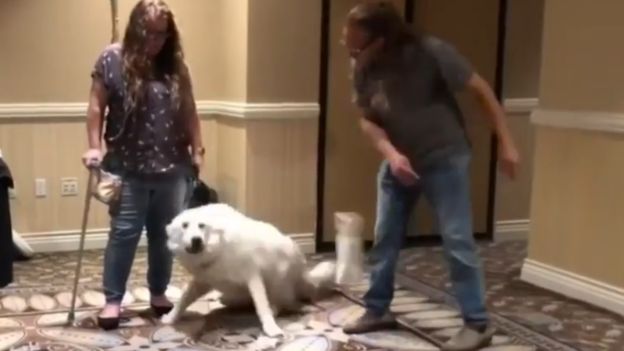
History often repeats itself and recently there has been controversy about an American dog trainer named Jeff Gellman visiting a seminar in Scotland. He is alleged to hit dogs with a rolled up towel and uses prong collars and remote control shock collars to keep dogs in line. The use of such instruments of torture are much used in North America and are readily available on the internet in the U.K. He has become another showman celebrity with tens of thousands watching his YouTube videos. Owners queue up willing to pay £750 for a session with him, but the Scottish SPCA were not happy about his visit or his methods and there is even a change.org petition against him. Dog training is big business and very lucrative but as always totally unregulated.

Genuine and sincere dog trainer or another showman – you to decide.

But his methods highlight the great division that still exists after decades of research and debate regarding the best and most humane way of training a dog to fit in with our modern lifestyles. Every self proclaimed dog behaviourist and trainer has their own ideas or choose the in fashion dogma of the day. But then everybody likes to think they are a dog expert.

The argument over negative and positive reinforcement.

The main division between the “experts” is whether “aversive” or “negative reinforcement” training i.e. using a bit of brute force like Mr Gellman and Barbara Woodhouse is cruel and counter productive and stress dogs out compared with “positive reinforcement” where dogs are bribed with treats and praised to toe the line.

A recent study published in the Journal of Veterinary Behaviour indicated that 65% of dogs trained with “aversive” or “negative reinforcement” (note we must have technical terms for all this) methods i.e. using punishment showed signs of stress such as mouth licking, shaking and whining compared with only 8% of those trained by “positive” or reward and praise methods. Whether this is scientifically sound or not, common sense dictates that hitting, yanking and electrocuting dogs is probably not the most humane course of action.

It seems to be human nature for us to always complicate issues and so we have established a new science: the science of animal behaviour in which we can become professionals, get diplomas and degrees, put letters behind our names, carry out research, argue, debate, write papers and come up with exactly nothing conclusive or tangible. We now live in a world of dog behaviourists, clinical animal behaviourists, psychiatrists, counsellors and a variety of trainers to make dogs compliant and contented with our modern lifestyles.

One side of the argument maintains that the positive approach leads to them being spoilt and entrenches bad behaviour whereas those against the punishment approach believe it causes mental trauma and impacts long-term welfare. Realistically the sheer act of training a dog to comply with our selfish demands is an act of dominance whatever method used to make it comply with our will. For many owners, like the exasperated lady on the promenade who was obviously at the end of her own tether, any method that solves the problem is OK with them, cruel or not.

Our lifestyles are the cause of their behavioural and mental health problems.

But ironically it is us who have inflicted our mental health and behavioural problems onto them through our lack of understanding of their needs. The world and our attitude to dog management and care has radically changed. They have to be under our control at all times and because of our hectic lives we have no option but to leave them home alone, fail to walk them as we should and generally do not give them the attention they desire. We have confused them to the point where they do not understand their role in our lives. We are barking up the wrong tree, if you’ll excuse the pun, by focusing on changing our dog’s behaviour. Perhaps we need a science of dog ownership to help guide us into being more thoughtful and responsible owners.

I do wonder if we read too much into dog training. I have little practical experience of dog training. I have always been willing to put up with the odd foibles a dog of mine might have and find ways of circumventing any problems that might arise because of them, rather than destroying their will and individual character, but this method doesn’t have all the answers either.


Animal Rescue intake policies explained

It is that time of year when animal rescues the world over brace themselves for a rush of unwanted and abandoned animals, but how easy is it to part with a pet? In this modern era of disposable pets, the acceptance of unwanted animals by the larger independent and national animal rescue charities has become an extremely complex operation.

Should unwanted animals be turned away because they do not fit the right profile?

They have been forced by our reckless pet ownership to use animal profiling and retail business practices in order to cope. They have to aim for a quick turnover by maintaining a balance of products (animals) to satisfy the whims and needs of potential customers (adopters) and measure their success by the amount of merchandise they shift. This is particularly so with dogs.

This means that for many owners it is no longer a simple case of fronting up or telephoning your local rescue and expecting to have your pet accepted for rehoming. It can be a long process or you may be refused altogether if your dog does not fit the required profile.

The continual overpopulation of dogs and cats in most countries forces rehoming rescues to be “selective” in what animals they accept as they cannot afford to take in too many animals that “clog up” their kennel space such as the old or sick, those with severe behavioural problems and unpopular breeds such as Bull Terrier type dogs.

Understanding the world of Selective and Non-selective intake policies.

Most professional organisations have a mission statement and what is called an intake policy on their website. These lay out the ethos of the charity and govern the circumstances under which they will accept or refuse to take in your pet for rehoming. These are normally a selective or a non-selective open door policy. Some charities try to use the term non-selective to their advantage in the compassion stakes by highlighting it in their literature, decrying others for not doing so.

The U.K. Battersea Dogs and Cats Home is one charity that follows a “NON-SELECTIVE” policy and states that:“Our open intake policy is increasingly rare in the animal rescue sector and it’s at the heart of everything we stand for”, but still accepts that this is “subject to space”.

Our mission is to never turn away a dog or cat in need of our help. Subject to space, we will open our gates to all dogs and cats in need of care and shelter and we will do all we can to either reunite them with their owners or to rehome them into loving new homes”

Battersea Dogs and Cats Home mission statement.

Acceptance by animal profiling

Rescues strive to maintain a balance or varied choice of breeds which are appealing to the whims of adopters. They accomplish this by refusing the difficult ones and concentrating on the young, healthy, well behaved and attractive breeds that provide a “quick turnover” with the least outlay and cost, referred to by some in the industry as the “desirables“. Organisations which have a selective policy either make a judgement on the telephone or by a suitability selection interview whereby the owner brings the dog in to be assessed.

Yorkshire Terrier puppy, desirable breed
Understandably, desirable dog types are far easier to rehome, but what about the less desirable.

When refusing an animal most charities helpfully put details on a waiting list, often never to call back, and give owners a list of telephone numbers, websites and addresses of other rescues that might be able to help. In reality these are generally full as well and when contacted commonly try to refer owners back where they started It can become a frustrating nightmare merry-go-round to part with a pet.

No Kill policies and the fate of undesirables

By using these strategies, U.K. charities have the luxury of not killing healthy unwanted animals and would not dare do so as it would be suicide for them. But local authorities do still kill an estimated 2,000 stray dogs each year which generally passes almost unnoticed as does the fate of those turned away from rescues.

Unfortunately charities in most other countries which suffer from huge populations of stray, roaming and unwanted dogs and cats only have two options: either leaving them to their fate or to euthanise many of them to make room for others. And this happens in many or our well regulated civilised countries such as the U.S.A where an alleged 2-3 million dogs and cats, representing 36% of those handed into rescues, are killed each year, many of them healthy.

Although these shelters and staff are declared evil and heartless, the guilt solely lies with the irresponsible owners who put them in this situation and society’s failure to get on top of the problems.

If being ‘selective’ means more lives saved, then selective we will be

A year or so ago I read an interview with a executive of a dog rescue who summed up the present situation quite succinctly: “priority is given to dogs most likely to be rehomed, and when taking in dogs, we generally look for those that have a good temperament and are not incurably ill. Those with temperament problems have to stay longer for training and the longer they stay the fewer dogs we can save and those that pose a risk to staff are not accepted. Good temperament is important as we want dogs to share kennels helping to maximise the numbers of dogs saved. If being ‘selective’ means more lives saved, then selective we will be. We are in control of which dogs come into our centres. We do not have breed specific policies but do seek to ensure that our centres do not become full of any one particular breed.

The major issue that arises with these polices is the fate of the unpopular, difficult and elderly dogs which are refused, the undesirables so to speak . In many ways the whole system seems biased against them and yet they are possibly the most vulnerable to ill-treatment, abandonment or being passed on to unsuitable owners via social media and arguably most in need of compassion and help. So should charities be more concerned about the future welfare of those turned away.

In fairness most rescues do their upmost to accept as many animals as possible, but in reality find themselves fighting a losing battle and for this reason can only pick and choose. Charities the world over cannot be blamed in anyway for whatever decisions they may make in order to cope with our selfish attitude to pet keeping. Until the time arrives when we make serious attempts to solve irresponsible ownership once and for all, the demand for space for the unwanted will sadly never decrease and tens of thousands will spend the yuletide in cages.