Finn’s Law. Do police horses have enough protection

The scenes at the Black Lives Matter protest in London of a police horse bolting riderless down Whitehall past the Cenotaph in terror while others came under attack with bicycles, flares, fireworks and other missiles was quite a poignant reminder of the war horses, and raises the question of whether they have enough protection under Finn’s law. Conservative MP Andrew Griffith thankfully responded to the issue by asking this question of Priti Patel in the House of Commons on Monday 8th. June, 2020:

“I am proud that it was a Conservative Government who introduced Finn’s law to protect our service animals. Will my right hon. Friend assure me that she will not rest until the minority of thugs involved in attacking the police horse, as well as, of course, our brave officers, are brought to justice?”

In response the Secretary of State for the Home Department said:

“My hon. Friend is absolutely right. What we witnessed at the weekend was utterly despicable. I look forward to visiting the mounted police section quite soon. I have had it with authority from the Metropolitan Police Commissioner that the injuries to the horse were mild, but importantly, she highlighted yet again how the acts of thuggery are disproportionate to not just police officers, but the animals”.

Finn’s Law named after stabbed police dog.

Coincidentally Finn’s Law or as it is formally named The Animal Welfare (Service Animals) Bill came into force exactly a year to the day these incidents occurred. It was named after a German Shepherd Dog that was stabbed chasing an offender and is designed to protect service animals. It was heralded as the answer to protect them but cannot be effective unless it is enforced stringently and greatly publicised to make possible offenders aware of the protection these animals have and the consequences of injuring them.

But there is also a great need for police horses and dogs to be treated in the same way as the officers when it comes to health and safety assessments of their use in each specific operation or situation. Obviously the real answer is not to use them in the first place. In this instance it did not seem sensible or safe for them to be utilised in a charge of the light brigade type onslaught in wet weather conditions to frighten and push a mob from the streets. I am surprised that horse charities and the RSPCA are not more vociferous over this issue. The incident received press coverage across the world which is not a particularly good UK animal welfare image.
Related articles:

From ant to elephant, come fly with me. The farce of ESAs.

Here is a conundrum: what is the difference between a companion pet and an emotional support animal or an ESA as we apparently need to call them?

For those not familiar with this relatively new phenomenon, an ESA is an animal not trained to perform a specific task to aid a disabled person in the way that service animals like guide dogs are, but only provides comfort and support in the form of affection and companionship for any individual suffering from a mental or emotional condition.

In a rational world the answer to the above question should be that there is no difference as ESAs are just people’s pets. I have always been under the impression that companion pets were bred over generations to perform this purpose, but for some reason we feel the need to give some of them special status. But the real question is whether by just giving them a different title they should be allowed to be used to cause so many problems for airlines and their passengers.

ESAs have no legal status

Service animals have many legal rights in most countries such as accompanying their owner into hotels, restaurants and on board aircraft whereas an ESA has no legal status, but a few countries such as the USA appear to foolishly allow them to travel in aircraft cabins and they are now paying the price. ESA ownership and registration has become a burgeoning industry in the USA, fraught with accusations of fraudulent use.

For a pet to become an ESA they have to be certified as serving a purpose by a health professional so that they can legitimately accompany the owner on aircraft but this has led to a trade in providing alleged fake certificates from online sites. Some have suggested that there are now more fraudulent support animals then there are legitimate ones.

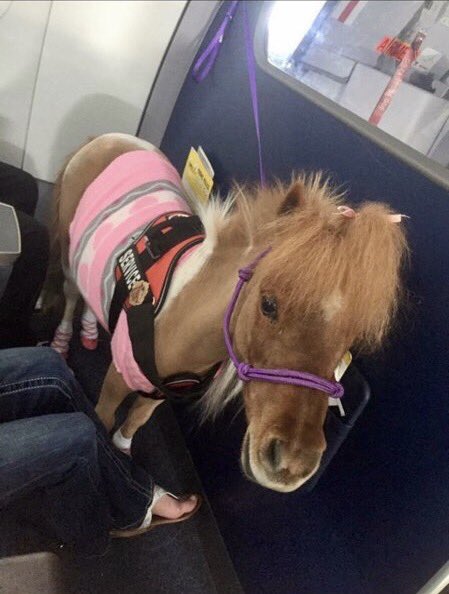
Now the situation has been compounded by the U.S. regulatory authorities designating mini horses as suitable service animals which forces airlines to carry them as well. It is difficult to see where this madness will end.

ESAs can be an ant or an elephant

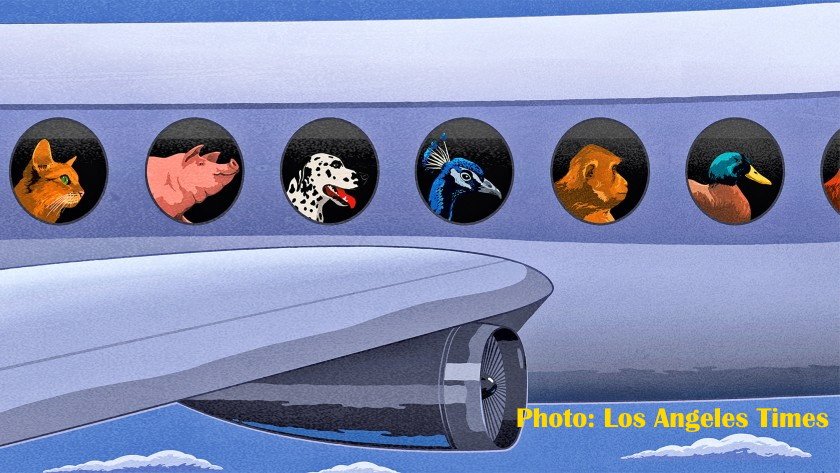
Over the last few years, the whole situation has become a circus – literally. Because these pets do not require specific training, they can be anything from an ant to an elephant. This is why social media is full of photographs of mini horses, goats, kangaroos, snakes, peacocks, ferrets, lambs, and parrots. Social media in fact loves it with cute and light-hearted videos and photographs making the practice appear fun for all concerned, but on the other hand is it much fun for the animals and other passengers. Many cabin crew also seem to find it “cute”. They may be a comfort to the owner but who is comforting the animal. It has even been known for passengers to bring a support animal to support the support animal.

ESAs are just pets?

It has become such a problem that the US Department of Transport is seeking to amend the transportation regulations in 2020 to ensure that “our air transportation system is safe for the traveling public and accessible to individuals with disabilities” and to recognize ESAs as pets rather than service animals. The new rules would not ban airlines from accepting ESAs but would not require airlines to take them and each individual airline could enforce their own rules.

Delta airlines reportedly carries 700 support animals daily and 250,000 annually and they have seen a 84% increase in hygiene and biting  incidents. In 2018 United airlines apparently saw a 75% increase and carried 76,000. It is so out of control that airlines have been compelled to constantly change policies and to compile and amend lists of animals they will accept as well as provide extra forms to complete in regard to the behavioural nature of the animals and insurance risks.

No one seems to be addressing whether all this is necessary in the first place. And have also overlooked the needs of fellow passengers who may have allergies, phobias or just have no wish to travel with a menagerie.

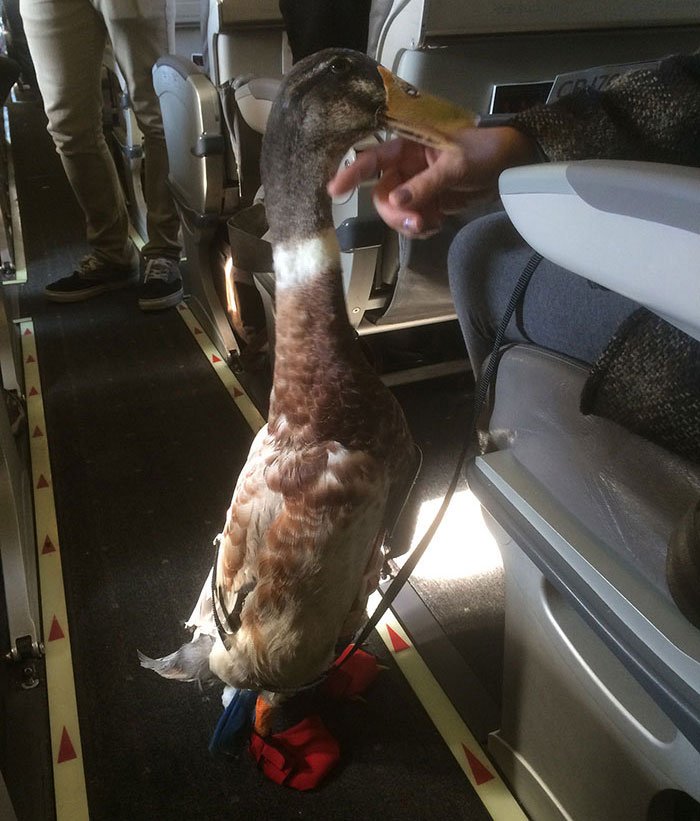
pet duck on aircraft

Could this happen in the U.K.?

Unfortunately while the USA wrestles with the problem, UK airlines who sensibly do not allow ESAs in the cabin, could face similar problems. There are certain groups in the UK keen to introduce the practice here such as the UK Emotional Support Animal Registry established in 2017 who are pushing for similar legal recognition for dogs and cats which could then give leeway to force airlines to accept them.  

Having once spent many years as an animal health inspector at Heathrow Airport enforcing rabies, bird import and animal transport welfare regulations I spent a lot of time catching escaped animals on board aircraft and haranguing various american airlines particularly Pan Am for allowing animals in the cabin. I was called to assist many dogs and cats which were wedged into small containers designed to fit underneath the seats and took many prosecutions for causing what back then we deemed unnecessary suffering and I would hate it all to begin again.