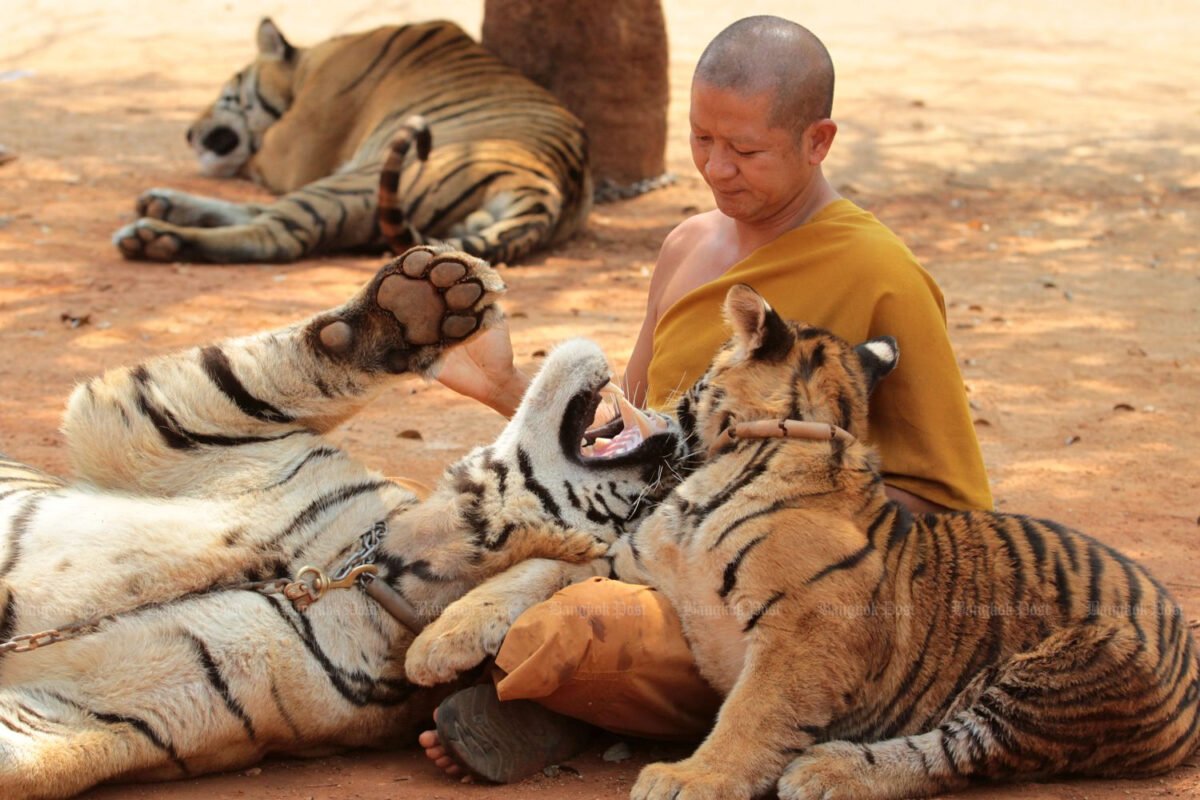
Buddhism is viewed by most people as an animal friendly and compassionate religion and therefore it came as shock to many when in the last few years Buddhist monks have been heavily criticised for their alleged involvement in wildlife smuggling and operating petting zoos in their temples. They have been accused of surrendering to contemporary desires and renouncing or ignoring their teachings. This was all in response to the worldwide condemnation of the so-called infamous “tiger temple” near Bangkok in Thailand where monks kept 134 tigers chained and drugged for tourists to feed, stroke and photograph as well as allegedly selling body parts and making millions of dollars. Unfortunately, this was not an isolated case.
Whether they are knowingly involved or not, the presence of monks give credence to these “attractions” and are an added photo opportunity for those misguided tourists who, like the monks, tragically see no harm in them. The monks at the tiger temple believed that they “lived in Buddhist harmony with the tigers” which seems to prove how disengaged they are from their basic teachings of loving kindness.
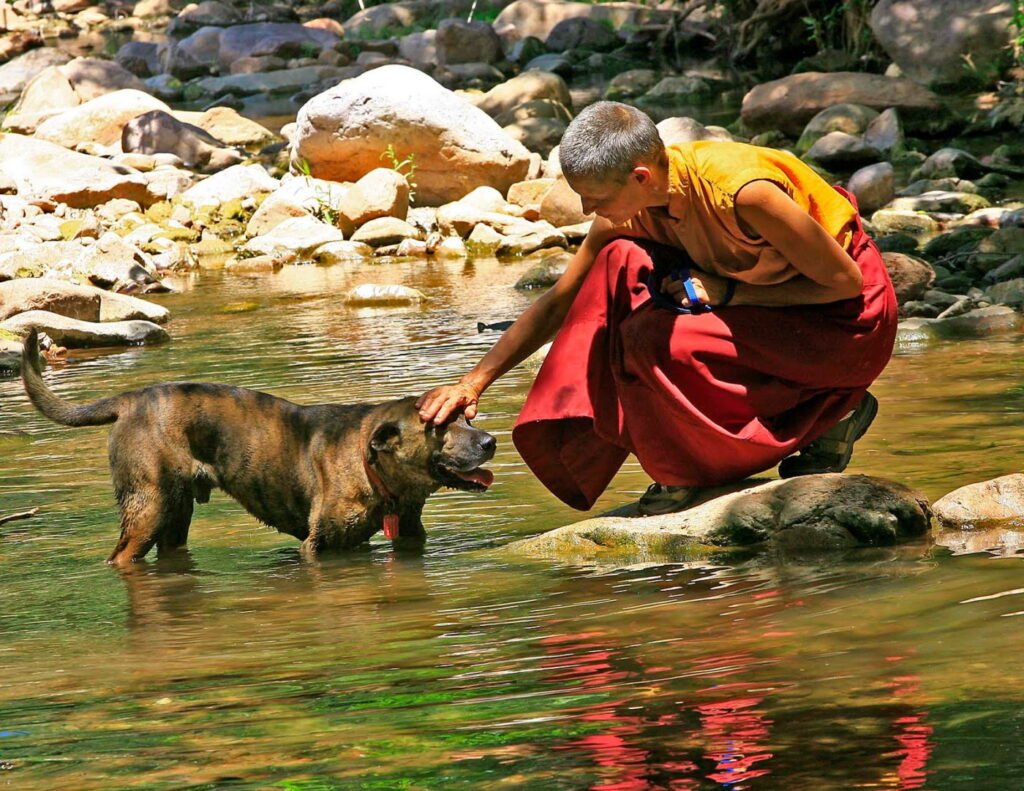
Caring for street dogs gives Buddhism their compassionate reputation.
But like all religions, Buddhism gives mixed messages in regard to animal well-being which is not necessarily understood. If you visit any Buddhist temple in Asia you will find dogs and cats wandering the temple grounds or monks feeding visiting troupes of monkeys. It is common practice to see monks keeping, feeding and looking after street dogs and cats and collecting food to feed animals at a local zoo. This is what gives them their compassionate reputation.
But at the same time if you search you will also come across miserable monkeys, birds and reptiles being kept in filthy conditions in tiny cages, often hidden in a compound corner, or a miserable chained elephant. It is a confusing situation.
Buddhist precepts or oaths do not support the domestication of animals and discourage the practice of keeping pets because they believe it is enslavement and stops them from being able to fend for themselves, but once tamed humans must care for them. This explains their compassion towards dogs and cats. Many Buddhists believe that keeping wild animals as pets breaks the third Precept of deriving pleasure at the expense of other sentient beings and also adds to the endangerment of the natural environment by removing animals from it.
Others interpretit it differently and believe that a human soul can be reborn as an animal for past misdeeds and their souls must continue to be reborn as animals until their bad karma is exhausted, which has led some to view animals as being inferior and justifies their exploitation and mistreatment.

Some of their rituals cause animal suffering and detriment to the natural environment such as Fang Sheng which involves catching wild animals and birds and releasing them back into the wild to gain merit. Despite this, Fang Sheng is widely practised throughout the world.
Being a Buddhist monk is not a career for most.
For most Asian monks it is not a life long devotion or career as in western cultures. Most males in Buddhist culture are expected to become a monk at some point in their life either as a novice when a boy or by joining at twenty as a monk. They can prove their commitment to the religion just for a day, a month, a year or in a few cases for life and therefore the ‘short-termers’ may not necessarily be ardent devotees. Many only become a monk as a precursor to marriage because the bride’s parents have insisted on it.
It is therefore not surprising that some of the transient monks might be led astray into nefarious activities when opportunities for financial reward and personal aspirations present themselves. Although some followers may have lost their way and fail to understand the wider moral issues involved in exploiting animals for their own indulgence, there are many who no doubt care for animals. But it would seem that Asian Buddhism urgently needs a little house cleaning in order to maintain its reputation as a true animal friendly religion.