Finn’s Law – better late than never.

Finn’s law came into force in June, 2019
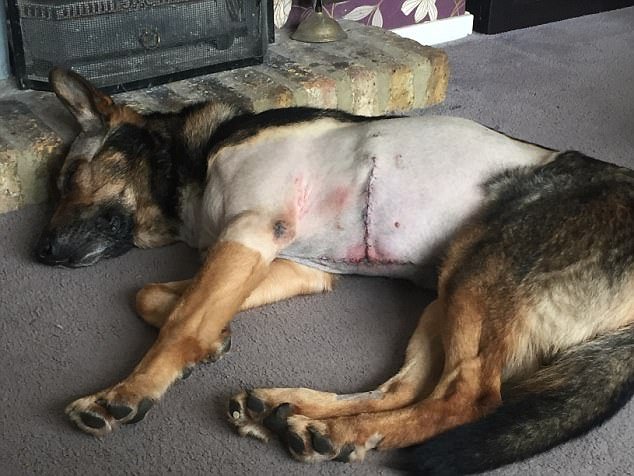
Injured German Shepherd with stab wounds.
Finn the police dog with stab wounds to head and chest soon after major surgery to save his life.

Why did it take so long to protect UK police dogs and horses with Finn’s Law.

Until recently police dogs and horses have always been treated just as a piece of police equipment or property. Countries have been extremely slow at recognising the need to protect them and it has often taken too many tragic incidents and thwarted campaigns to force lawmakers to do so. The UK, the great nation of animal lovers, has followed its usual path in lagging behind other countries in protecting service animals and like most countries has only done it through public pressure.

New Zealand has protected its police dogs since 2008 with the Policing Act 2008 (Killing or injuring Police Dogs) and has recently increased the punishment under the Policing (Killing a Police Dog) Amendment Bill 2016 to 5 years in line with many other countries and 2 years for injuring a dog plus a NZ$15,000 fine.

The USA has had protection in place since 2000 under the Federal Law Enforcement Animal Protection Act with up to 10 years in prison and a $1000 fine for assaulting, maiming or killing federal law enforcement dogs and horses following many attacks on them and drug dealers putting bounties on narcotics sniffer dogs, but State laws vary.

Police dog handlers have to fight for the rights of their dogs.
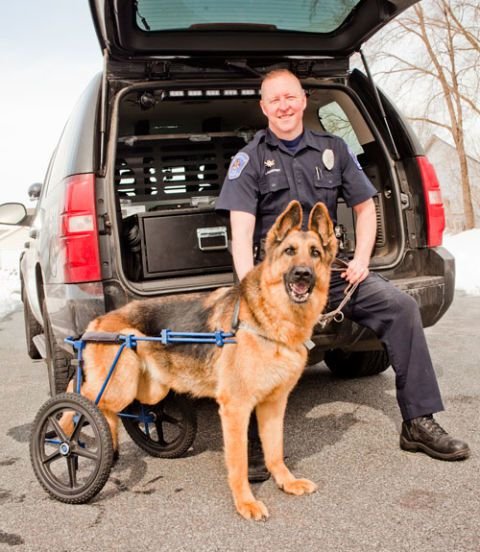
Finn's Law. Injured police dog
Major the police dog paralysed in a stabbing with his handler, Officer John Jorgensen.

On the 12th. November, 2010 in Roseville, Minnesota, USA, Officer John Jorgensen sent  his police dog Major into a wooded area to chase after intruders and within minutes he found Major covered in blood and rushed him to the vet where he was found to have suffered four stab wounds puncturing the lung and damaging the spinal cord resulting in permanent paralysis of his hind legs. Although it was a felony to kill a state police dog, assaulting one was treated at the time as a mere misdemeanour so the attacker only served 4 months. The officer was so appalled at the lack of protection of his partner that he began a campaign for more stringent laws in the State which he succeeded in.

In August 2013 in Adelaide, South Australia a police dog named Koda was  stabbed in the chest in the line of duty when he caught up with a knife-wielding man following a burglary. He was stabbed in the chest causing a 8 c.m.-deep wound and was rushed to a vet where he underwent emergency surgery and survived.  The incident was greeted with public outrage as no law existed to prosecute the offender and following a campaign a new law, known as “Koda’s Law” was introduced.

Finn's Law. Police horses wearing eye and face shields and leg protection.
We are already having to kit police horses out with protective gear to avoid injuries.

On the 5th. October, 2016 in Stevenage, Hertfordshire, UK a 16-year-old boy stabbed a police dog named Finn in the chest and head causing life threatening injuries, but he survived following surgery and weeks of treatment. It sparked outrage and there was a campaign, including a website and Facebook page for Finn, involving his handler PC Wardell to enact a law to protect them , something that should have been included under the Animal Welfare Act back in 2006 but was either overlooked or not felt necessary.

UK Government slow to introduce Finn’s Law and come to the rescue of police dogs and horses.

A petition was launched which stated “I propose that UK police dogs and horses be given protection that reflects their status if assaulted in the line of duty. This would be similar to the US Federal Law Enforcement Animal Protection”, but prior to the petition being debated the Government responded by saying “It is unnecessary to give police animals the same legal status as officers in light of the penalties already in place”. This was not helped by a delay caused by Sir Christopher Chope MP who unbelievably objected to the new proposed law.  Such is the UK’s commitment to animal welfare.

Despite this a new amendment, the Animal Welfare (Service Animals) Amendment, to the Animal Welfare Act, which has been dubbed “Finn’s law,” was finally  debated by the Lords and came into force on 7th. June 2019. It is obviously better late than never but it seems sad that we haven’t found it necessary to help our police dogs and horses much sooner.

Is it time to reduce the usage of animals on front line duties?

Having such a law is obviously to be applauded, but it is not unfortunately going to solve the problem of attacks on police animals in the future and brings into focus the danger we put these animals in on our behalf. It raises the question of whther it is ethically and morally fair to intentionally put animals in harms way in the first place?  Would it not be better to restrict them to ceremonial use or purely as “search” and “sniffer” dogs who appear to have a fun time at work.

Updated June 2020

Top animal charities spend £500 million a year saving unwanted animals.

Are animal re-homing charities failing animals?

We all know that the thousands of animal “re-homing” charities in the UK and around the world are doing wonderful work in finding new homes for hundreds of thousands of animals each year, because they are quick to tell us so and we see their great work depicted on television documentaries and in the press. As donating public we revel in the glow of sad stories and happy endings of animals finding forever homes and for this reason we throw millions at these charities to enable them to continue.

The top eight UK charities spend £500,000,000 each year to support the infrastructure to “save” and “rescue” animals from us humans. In the case of the Dog’s Trust, the UK’s leading dog charity, this works out at £8,100 per dog to care for and re-home the 13,141 dogs (2017 figures).

It would seem on the surface that the animal re-homing charities are doing a really good job and making the most of the money we give to them, but should they judge their success by the number of animals they take in and re-home or by what they are accomplishing in reducing numbers in the first place.

The Humane Societies of the United States (HSUS) is constantly criticised for not giving enough of their funds to animal shelters, but they once succinctly responded by declaring that their aim was to “prevent cruelty and stop animals entering animal shelters in the first place”. It could be argued that the re-homing charities are perpetuating the problem of irresponsible pet ownership by offering a free service to accommodate and re-cycle unwanted pets, strengthening the creed that they are disposable objects.

Each year the number of unwanted and abandoned animals never seems to decrease.

Are animal shelters just re-cycling plants for irresponsible owners.

Each year the major UK animal re-homing charities take in tens of thousands of unwanted dogs, over a hundred thousand cats, thousands of horses and donkeys and hundreds of thousands of rabbits and other small animals. All these figures could probably be doubled, trebled or even quadrupled if you consider the numbers taken in by the hundreds of smaller UK charities.

Local authorities supposedly dealt with 7,000 stray, abandoned and unwanted dogs in 2017 of which over 2,000 were put to sleep although these figures seem far too low. The Cats Protection charity alone cares for nearly 50,000 cats annually.

If official figures are correct, we are supposedly getting on top of the abandoned and stray dog numbers on the streets, but half of the dogs that the Dog’s Trust accept, 6,500 (2017 figures), are strays from local authorities. Any slight decrease is more than matched by the increasing number handed into animal rescue centres by fickle owners so the status quo remains despite continuing campaigns and free neutering. This results in more facilities opening to cope with the continual flood. To make matters worse we are increasingly importing other countries’ stray and unwanted animals. We have had a cat and horse crisis for several years now and an increasing problem of unwanted exotic pets which has resulted in even more charities to rescue them.

While charities are happy to continue picking up the burden there is no incentive for the government or the law to intervene or take notice. The UK Government almost entirely washes it hands of the subject and even relies on animal charities to collate figures on the state of our animal keeping habits such as the RSPCA with their cruelty figures and the PDSA with their PAWS survey otherwise we would have no idea of the problems.

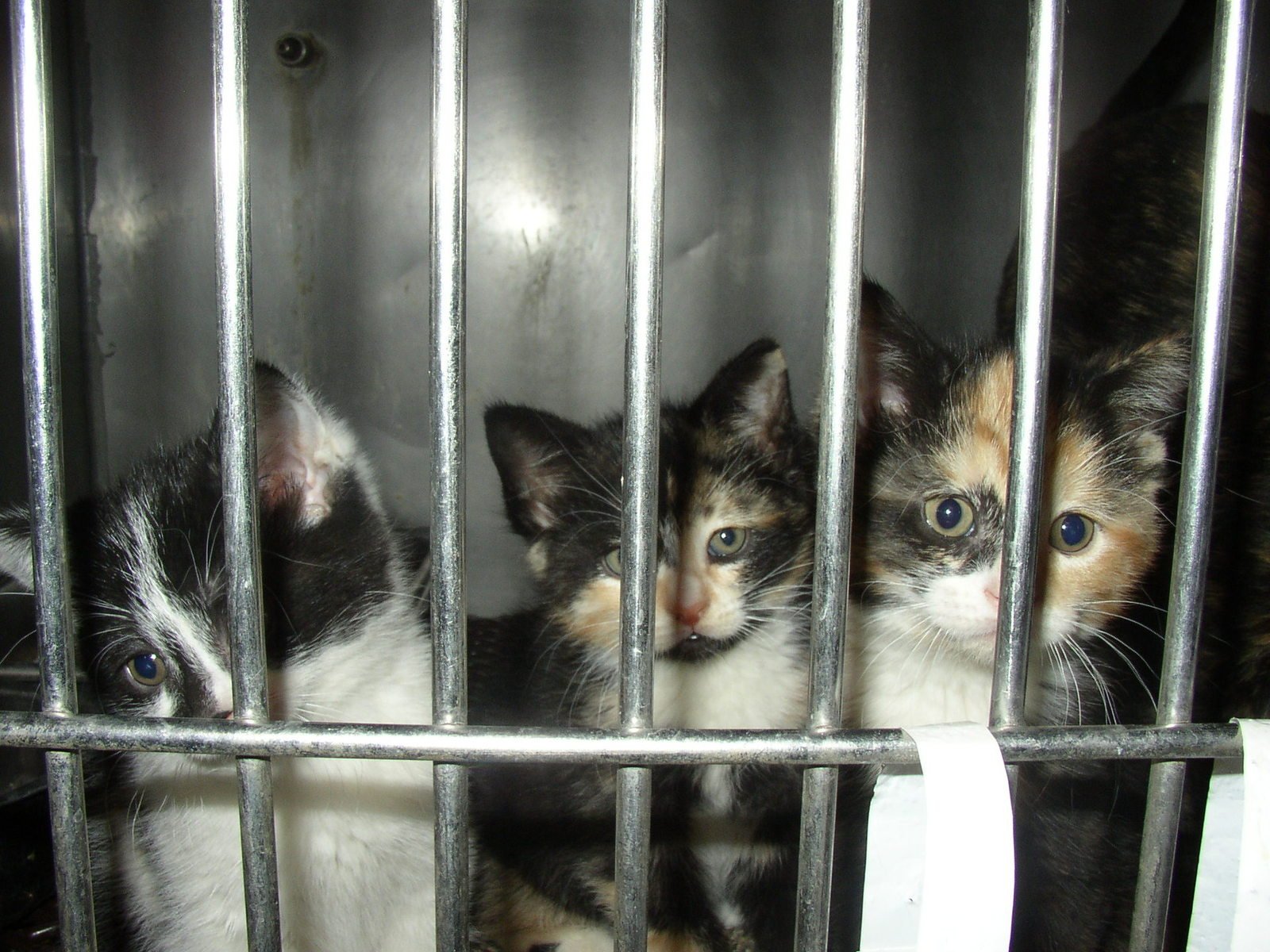
Kittens, rescue, animal rescue,, abandoned, unwanted
The number of stray and unwanted cats in the UK is incalculable.

There must be more to animal welfare than just re-homing dogs and cats.

The charities will argue that they only exist for this purpose, but surely this is a short-sighted outlook and instead of proudly proclaiming the increasing numbers they are finding homes for, they should strive to decrease the numbers becoming unwanted in the first place.  There must be more to animal welfare than just re-homing dogs and cats, but most charities seem happy to just tread water, accept the status quo and never make inroads into solving the major welfare problems. Do we just accept this as a fact of life and money well spent or should we expect more from them? Perhaps it is time for a completely new mind-set.